Saturday, July 9, 2016

Scoop

Year: 2006
Genre: Comedy
Directed: Woody Allen
Stars: Scarlett Johansson, Woody Allen, Hugh Jackman, Ian McShane, Julian Glover, Romola Garai, Fenella Woolgar, Matt Day, Tina Rath, Charles Dance
Production: BBC Films

Woody Allen doesn't make bad films. At his best he makes films that are absolute treasures of the filmmaking craft, made all the more memorable by the writer/director's sonorous one-liners and punchy zingers. He can also make films that are strikingly ordinary; held together only by a few frivolous if easily relatable quibbles and the charm of its cast. Scoop is not one of Woody Allen's finer films. In-fact despite hosting the effervescent charm of Scarlett Johansson as its lead, it's barely even passable.

The story begins with former journalist Joe Strombel (McShane) standing along the shores of the river Styx with death himself. He strikes up a conversation with Jane (Woolgar) a recently deceased secretary who swears she had her coffee poisoned by her boss. She's convinced her employer Peter Lyman (Jackman) is the "Tarot Card Killer," who has been terrorizing the citizens of London for months. Enter journalism student Sondra Pransky (Johansson), a good girl from Brooklyn who takes in a magic show hosted by bargain-bin magician Sid Waterman (Allen). While volunteering for one of Sid's chintzier tricks, she accidentally summons the spirit of Joe whom may have the biggest tip she's ever received.

Woody's reaction to the box office returns of Irrational Man (2015)
By the sounds of it, Scoop has all the familiar trappings of your average Woody Allen gig; an ensemble falling in and out of love, working-class insecurities played against a backdrop of high-class social circles, the inevitable specter of death played for laughs. Adding in the convoluted plot of murder and betrayal and a fine performance by Hugh Jackman, Scoop had a story to rival Manhattan Murder Mystery (1993). Unfortunately due to two big glaring errors, Scoop remains relegated to the Curse of the Jade Scorpion (2001) pile.

Hi! I'm Sondra and I'm surprisingly affable.
The first error was casting the rapturous Scarlett Johansson as the endearingly classless Sondra Pransky. The very name conjures a Midwestern milk-maiden thus the character calls for being charming in her own pedestrian flightiness; She talks of being Katharine Hepburn sure, but she's ultimately the type of girl who one could easily talk to and share your secrets. Far be it for me to limit the range of Ms. Johansson. She has played the femme fatale and the permissive interloper to great aplomb in Match Point (2005) Vicky Cristina Barcelona (2008) respectively, yet ordinary she certainly is not. Not even a masters course in at the Sorbonne and Monster (2003)-style makeup could have made her blend to the degree Allen needed her to.

At least he's stopped playing the romantic lead
The other problem is Allen himself whose still pulls the same shtick that's served him well since the days of the 1960's late-night talk show circuit. It still works but as a vessel for quick quips and erudite wordplay, Woody Allen the man looks like dotty old man clinging to his comedic career like the Great Calvero. Are we truly meant to believe that Sid Waterman's tired magic show is enough to warrant Ricky Jay level audience attendance? Even in his prime, Allen had the stage presence of a salamander newt. In may ways that was part of his charm.

Yet beneath a few casting missteps there is still a good story to be told. Allen aptly balances the more morose themes with a light touch proving that even at his worst he can mix the bleakness of Ingmar Bergman with the absurdity of a David Ives. And you can tell by the subtle visual motifs that Allen still has a sharp cinematic literacy, calling back to classics like Suspicion (1941) and A Place in the Sun (1951).

Woody Allen doesn't make bad films. I write this knowing that as an unabashed fan and completest, I will one day have to sit through Anything Else (2003). Yet if anyone is more deserving of a pass it's Woody Allen. He's made a feature film every year since 1969; most of which are not only good but award worthy. Scoop won't win any awards and certainly won't be anyone's favorite but with a breezy and fun little story, at least it's not a total failure.

Final Grade: D-

Friday, July 8, 2016

Timbuktu

Year: 2014
Genre: Drama
Directed: Abderrahmane Sissako
Stars: Ibrahim Ahmed, Abel Jafri, Toulou Kiki, Layla Walet Mohamed, Mehdi A.G. Mohamed, Hichem Yacoubi, Kettly Noel, Fatoumata Diawara, Adel Mahmoud Cherif, Salem Dendou
Production: Cohen Media Group

Timbuktu won the Francois Chalais Award at Cannes in 2014 and was nominated for Best Foreign language film at the 2015 Academy Awards. It's easy to see why. Not only is it a beautiful, serene and well-made film but it also has the fortitude to take on radical Islam in a brash, yet compassionate way. The fact that this film and director Abderrahmane Sissako has been readily accepted by the western world is not only evidence that audiences are willing to see films depicting extremism, but are willing to accept a more nuanced version than the caricatures we've conjured in out own minds.
Caricatures like this...
There are many stories covering the breadth of Timbuktu, though the main and most powerful tale concerns Kidane (Ahmed) and his family. Kidane, his wife Satima (Kiki) and daughter Toya (Walet Mohamed) live on the outskirts of town as a family of cattle herders. For the most part they're far away from the oppressive world of the Ansar Dine occupation that took over the ancient city of Timbuktu from 2012 to 2013. The only encounters they seem to have is between Jihadist (and driver in training) Abdelkerim (Jafri) who covets Satima. One day a local fisherman kills one of Kidane's herd. From there the Jihadists converge on the family, administering their harsh interpretation of Sharia Law.

There are many side stories that decorate the edges of Timbuktu's moral parable. While these stories don't necessarily provide interesting characters they do provide some arresting images. An audacious woman known by the locals as La Chanteuse (Diawara) constantly employs subtle forms of silent protest against the city's occupiers. The simplicity of her protests provide the film with some iconic images. In one scene another woman is given twenty lashes for singing and being in a room with a non-relative man. As she sobs with every stroke of the whip, she begins to sing in a singular act of defiance. Another almost absurd aside includes a group of school children playing soccer without a ball since the sport itself is forbidden.

The Jihadists themselves are portrayed as foolish hypocrites; sneaking smoldering puffs of cigarettes smoke and conversing about their favorite soccer teams when no one is watching. When two of them try to enter a mosque with weapons, the local Imam (Cherif) curbs their excesses with sermons on humility, leniency, respect and kindness. Their reactions are often ones of puzzlement, unable to keep up with the Imam's learned discourse.

Yet it's moments like these that provide the film's biggest trouble spots. In an interview with Al Jazeera, Sissako explained that he's trying "to speak on behalf of people who are frustrated with this image...this constant degrading image of Islam." To that end Timbuktu is less of the humanist work like his previous Waiting for Happiness (2002) and more like a classroom lecture. Many have latched on to the film's zeitgeist and made comparisons to The Great Dictator (1940). One could no doubt take Chaplin's closing monologue and feel the same sense of erudite pretension. Yet by coming out and saying what the film's about, it stunts the film's natural humanity. We reach points of tragedy, not with a sense of loss but with a narrative coda. One that resembles and argumentative rebuke.
Gee, I wonder what this movie is going to be about...
The film's discourse also feels unnecessarily chambered when you consider Sissako's larger point. It's easy to charge cruelty and hypocrisy yet the challenge is to examine why the world of Timbuktu is sullied by cruelty and hypocrisy. Issues of displacement, poverty, globalization, colonialism (all of which are familiar themes to Sissako) are completely absent. Nothing is left ambiguous and one could not help but think Timbuktu's international success is predicated on whittling away such themes for the sake of moral clarity. Even Kidane's home-life reeks of the nobility through poverty prosaism that hasn't been in vogue since Maxim Gorky died.

Abderrahane Sissako is certainly one of the most talented Cineastes coming out of Africa today. His visual grammar is on par with international contemporaries and his panache for emotional complexity makes him a torchbearer for Cinema's most renowned humanists such as Satyajit Ray, Masaki Kobayashi and Charles Burnett. Thus, Timbuktu ultimately feels like a compromise. The director's desire to connect with a larger (presumably) western audience seems to supersede the film's fertile narrative which is unfortunate. Yet by the merit of the film's imagery and some very potent religious themes, there is forgiveness, there is leniency.

Final Grade: C+

Tuesday, July 5, 2016

Haxan: Witchcraft Through the Ages

Year: 1922
Genre: Drama
Directed: Benjamin Christensen
Stars: Maren Pedersen, Clara Pontoppidan, Elith Pio, Oscar Stribolt, Tora Teje, John Andersen, Benjamin Christensen, Poul Reumert, Karen Winther, Kate Fabian, Else Vermehren
Production: Svensk Filmindustri

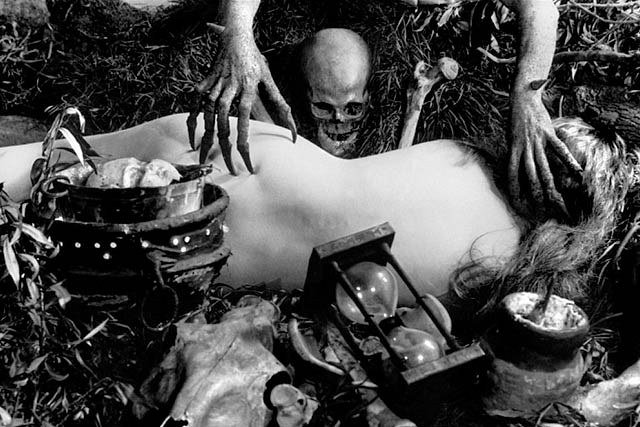
The concept of Haxan is deceptively simple. It's a dramatization of witchcraft throughout the ages providing reenactments largely based on the Malleus Maleficarum a 13th century witch-hunting manual. There isn't really a formal narrative though director Benjamin Christensen himself becomes the reoccurring character of the devil throughout the film's various vignettes. It's split into four acts: one setting the standard for what witchcraft is, two giving the audience rhetorical and increasingly surreal "evidence" of witchcraft and the last giving us a pat explanation for witchcraft in a modern context.

What sets Haxan apart from other surviving films of the silent era is it's attempt to construct a central argument and support it with "evidence" in the form of its reenactments. It doesn't work but the visual intelligence and editing of Haxan is leaps and bounds above anything Edison Manufacturing ever released. The comparisons between D.W. Griffith and Christensen are certainly well founded as Christensen provides coherence and insight amid the film's proto-surreal cinematography. He even provides some silhouetted animation that channels Lotte Reiniger's The Adventures of Prince Achmed (1926).

Yet just like Luis Bunuel's L'age d'Or (1930), Haxan sells itself as a documentary of sorts. The first act of the film struts across the screen with all the authority of an anthropology professor, dully pointing at this and that as evidence of witchcraft. There are still images of paintings and woodcarvings in addition to a moving diagram of the heliocentric solar system; all signalling to the existence of witchcraft in all its ugly, foul and murderous forms. As the other acts take over, so do our emotions. Only the "bad guy" as it were, becomes hypocritical clerics and gullible townsfolk. Are these poor desperate women victims of the times or are they truly accessories of the devil? It's clear the film wants to have it both ways.

The film ultimately deconstructs the act of witchcraft from one of maleficence and devil worship to one of mental illness; cheer-leading for the current time's rational thinking winning out against superstition. It's this last act's classroom lecture-like prognostications, that stringently frames what we just saw in an un-disputable context, that ruins the film. It's as if we were put into a somnambulist trance; images of an almost existential nature filling our head with complex thoughts. Then like a blunt hammer, the film knocks us into reality and asks "what did you learn?" Plus, considering the film was released in 1922, we're experiencing a "modern" rationality that included the concepts of hysteria and electroshock therapy so Haxan isn't exactly the bastion of progressive thinking it thinks it is.

From a historical perspective, Haxan is an interesting little relic that provides some stunning visual tableaux that rivals Nosferatu (1922) in the horror genre. Yet as a narrative, the film is an absolute mess. It ruins any credibility it has by constantly employing heavy-handed metaphor, and at times outright saying "look how backwards we once were."


Final Grade: D+

Monday, July 4, 2016

Swiss Army Man

Year: 2016
Genre: Comedy
Directed: Dan Kwan, Daniel Scheinert
Stars: Paul Dano, Daniel Radcliffe, Mary Elizabeth Winstead, Antonia Ribero, Timothy Eulich, Richard Gross, Marika Casteel, Andy Hull, Aaron Marshall, Shane Carruth
Production: Cold Iron Pictures

Um, huh. I, umm huh. This may be one of the hardest reviews I will ever have to write. There's nothing that can be said about Swiss Army Man that hasn't already been said. Is it the long-lost, constantly flatulent cousin of Weekend at Bernie's (1989)? Yes. Is it a demented and contrived film that revels defiantly in its own quirkiness? Check. Is the film bizarre, ludicrous and stupifyingly unique? You betcha. Yet despite its polarizing Sundance premiere and it having been unfortunately dubbed " the farting corpse", there's no denying that Swiss Army Man is an emotional roller coaster and splendidly original sight to behold.

Seriously, Swiss Army Man may have a one-up on this movie
The film begins with the desperate Hank (Dano) standing on a small island somewhere in the north Pacific. What we can cobble together from context clues, Hank seems to have survived there for quite some time. He sports a scruffy beard, stands atop a cooler and is about ready to end it all. In enters Manny (Radcliffe) a blue suit sporting dead body who washed up on the shores of Hank's deserted island. Hank tries to resuscitate him but all he can conjure is a curious and consistent case of bad gas. Seeing Manny as a source for salvation, the unlikely duo try to find civilization in one of the most surreal journeys to be dedicated to the screen since El Topo (1970).

"And we're off on the road to-o Portland"
The relationship between Hank and Manny sits as a surprisingly earnest friendship that rivals some of the classic double acts (think Dean Martin and Jerry Lewis), right down to the inclusion of song. They bond over childlike ruminations of how and what things are in the real world, while arguing the validity of Hanks repressed memories and fantasies. Manny's appearance in Hank's life is quite lifesaving in more ways than one, offering a fools perspective on Hank's predicament. This is in addition to all the things Manny does in the trailer, i.e. shooting projectiles from his mouth, cutting wood with karate chop action and farting through the water like a foul-smelling jet ski.

What really sets the film apart is its ability to break down its themes in creative, new and occasionally frustrating ways. Just when you think you know where Swiss Army Man is going, it pulls the rug out from under you. The movie melts into a hallucinogenic hipster inspired fever dream. One minute our protagonist is fighting for his survival, the next moment there are Michel Gondry-esque fantasy sequences that emphasize tactility over whimsy.

Likewise the humor interjects itself in unexpected moments often undercutting some of the film's gravest moments. While in any other movie, this kind of glibness would crimp the narrative, with Swiss Army Man it not only enhances the film's themes but proves a check on the film's more intellectually preening sensibilities. The emotional and the intellectual build off each other in this film like a game of slap hands. Ultimately however, the film settles on an impressionistic tone that channels Terrence Malick through conduits as unlikely as the Farrelly Brothers.

The film then diverges into psychological drama before letting the audience decide what the hell happened. Where you fall on the ending feels almost like a litmus test. Do you stare at the existential void and shudder? Could Manny be a symbol of faith? Is a victory in your mind still a victory? How do you treat people? How should you treat people? Your answers to these questions should inform how you view the film and help you decide if the ending resembles the midriff of Badlands (1973) or the end of Monty Python and the Holy Grail (1975). I myself am still thinking about it; beaming, slightly teary-eyed and more than a little gassy while doing so.

Final Grade: A-

McCabe and Mrs. Miller

Year: 1971
Genre: Western
Directed: Robert Altman
Stars: Warren Beatty, Julie Christie, Rene Auberjonois, Willaim Devane, John Schuck, Corey Fischer, Bert Remsen, Shelley Duvall, Keith Carradine, Michael Murphy, Antony Holland, Hugh Millais, Manfred Schulz, Jace Van Der Veen
Production: Warner Bros.

Near the end of the film, a bounty hunter known as Kid (Schulz) perches himself on a rickety suspension bridge blocking the path of a good-natured cowboy (Carradine). After a brief exchange Kid shoots the cowboy; his body falls limp into the frozen lake below. The events that put these two minor characters towards a path of destruction are sadly mundane. It's the type of spat that could happen at a supermarket or while in traffic; it's senseless, it's disheartening and it's frighteningly real. There are plenty of intricately melancholy moments in the meandering McCabe and Mrs. Miller that resemble the cowboy's death, and all are taking common western genre traditions and putting them on their head.

Our titular protagonists are John McCabe (Beatty) and Constance Miller (Christie), two time-ravaged souls willing themselves to the ends of the earth for greener pastures. When we first meet McCabe he's a gambler who is rumored to have shot a man in a poker game. He shows up to the only saloon in the small mining town of Presbyterian Church and promptly wins a few hands before cashing out. Instead of spending his money on booze, he buys three whores from a nearby town and brings them to Presbyterian Church to start himself a racket. His luck improves with the arrival of Mrs. Miller a former cockney prostitute who bets she can make McCabe's budding business much more profitable.

By the sounds of it, director Robert Altman is constructing a western in the mode of Man of the West (1958) or The Far Country (1954) (albeit with a brothel involved). Yet given the idiosyncratic nature of Altman's entire filmography, McCabe and Mrs. Miller should never be mistaken for anything resembling a John Wayne vehicle. Altman gingerly picks apart story elements and purposely bastardizes them for the sake of revisionist experimentation. What was once noble is made cowardly. What was once legendary is made human. Iconic scenes of heroes gunning down bad guys against the noon day sun, are now early morning hide and seek games; the townsfolk none-the-wiser.

Altman once again imbues the film with his signature style. The camera never cuts back and forth between snippets of dialogue. It rather glides through the scene, taking in everything and everyone as people audibly converse amid the action. Life just goes on and on. Those who have seen and love Robert Altman films will enjoy his straightforward ensemble staging and complex sound design. Those who hate his films will only find more of the same though with a rebellious flair similar to his debut MASH (1971).

The major difference between McCabe and Mrs. Miller and the auteur's other works is a permeating sadness throughout. Shot in the cold, misty forests of British Columbia, there's nary a scene where flecks of precipitation aren't falling through the air. The town itself is a product of the surrounding wilderness; cobbled together from whole timber and resembling a work site started by amateurs without a blueprint. Then there are the frames of the film lovingly crafted by cinematographer Vilmos Zsigmond which echoes the dusty, dimly lit photos of our past; faded and ashen, drenched in sepia. All these little details conjure the idea that the film is consumed from the living past and the denizens of Presbyterian Church might as well be souls in purgatory. We feel for their plight, even if we know we can't help them.

Much like Godard's animus towards cinema du papa, Altman seems to be picking apart the western genre with the voracity of an angry child. There is a muted energy behind the camera. Small moments where you can catch a glimpse of the director's modus operendi; a larger set prostitute laughs gleefully at a gaggle of bathing women; Shelley Duvall's Ida comes to terms with becoming a whore after the death of her husband etc. Those moments strike the viewer as impassioned to be sure. I am personally torn between the films very purposeful demystifying of the old west and at times forceful indignation towards it.

McCabe and Mrs. Miller is certainly not for everyone, the least of all unabashed fans of the western genre. The film is an anti-western hitting the same notes as Pat Garrett & Billy the Kid (1973) though with a plodding, contemplative pacing that's makes it uniquely and wholly Robert Altman's. The film leaves the audience to discern what is true about McCabe and what is hogwash. Yet the character of McCabe sees himself as a dreamer; a man with the heart of a poet yet lacking the vocabulary or the agency to express himself. His relationship with Mrs. Miller is a cynical one. It's a cold, unforgiving, even a mean-spirited partnership at times that leaves the film with its one sour note.

Yet within the confines of its own cynical world, McCabe and Mrs. Miller is a superb film. It showcases beautiful and unique cinematography, solid period accurate art direction and some brilliant acting on the part of Warren Beatty and especially Julie Christie. The film certainly ranks among one of the best westerns if for no other reason than it singles out some of the common concepts embedded in the genre and mixes it with post-1960's sensibilities and cynicism. Finally, while those who were never fans if Robert Altman's oeuvre will find nothing new to really gravitate towards, there's no denying McCabe and Mrs. Miller is bar-none one of his best films.

Final Grade: B

Saturday, July 2, 2016

The BFG

Year: 2016
Genre: Fantasy Adventure
Directed: Steven Spielberg
Stars: Mark Rylance, Ruby Barnhill, Penelope Wilton, Jemaine Clement, Rebecca Hall, Rafe Spall, Bill Hader, Olafur Darri Olafsson, Adam Godley, Michael Adamthwaite, Daniel Bacon, Jonathan Holmes, Chris Gibbs, Paul Moniz de Sa
Production: Disney

In the highly adored Spielberg classic E.T. - The Extra-Terrestrial (1982), the protagonist Elliot lures the titular E.T. into his home using M&Ms. E.T. fumbles about the boy's room; they exchange glances, they mimic each other's movements, they greet each other. The BFG is an attempt to sustain the same sense of wonder Elliot feels when first meeting E.T. only this time replace Elliot with a precocious little girl named Sophie (Barnhill). It's a sense of wonder that courses through the film like the lucid flickers of a waking dream; it's majestic, it's magical and its unabashedly sentimental. Unfortunately, like waking up from a dream, a sudden stumble can really ruin the experience. A tossing turn can end a dream with an unceremonious thud which regretfully happens in The BFG.

So...anyone up for a game of touch football?
The film takes no time in introducing its audience to Sophie and BFG (Big Friendly Giant) played by Mark Rylance in all his motion capture glory. Sophie is whisked away from the orphanage she tolerates to Giant Country where BFG is but the small and abused runt of a litter of giants with names like Bloodbottler (Hader) and Bonecruncher (Bacon). The largest and meanest of them all is Fleshlumpeater (Clement) who is partial to eating children. After avoiding the keen noses of the nine cannibalistic giants, Sophie follows BFG to dream country where the lonely giant bottles dreams and shares them with the sleeping children of the world.

The BFG is based on a children's book of the same name written by Roald Dahl. The film remains highly faithful to the book almost to a fault. It takes a while to really get into the world of The BFG partially because of a near constant injection of whimsy. Thus for the first half-hour we must be guided by a sea of linguistic context clues and Sophie's stubborn pluck. Seriously, these giants sound like Eliza Doolittle had a run-in with Alex and his droogs.
My babblement keeps getting all squiff-squiddled around!
Yet eventually like a seedling, the film grows on you. It replaces its moments of caprice and forced mawkishness with real sentiment. It's coaxed largely by the growing relationship between the child and the giant, one of which has surprising cleverness while the other has a folksy simplicity about him. It is moments like the ones in dream country that are not only a feast for the eyes but provide the very best narrative charge to elevate the art of film itself.

The beauty of The BFG and director Steven Spielberg's entire oeuvre is his ability to world-build. Spielberg doesn't just give you the tour, he envelopes you into a fiction you can almost touch. It certainly helps that he lets his actors interact as much as possible with the intricate details and adorning accouterments. A lesser director would have cut corners, making and updated version of The Devil-Doll (1936) but not Spielberg. Every hoist of the giant's hand, every impish step and every jump into a snozzcumber gives a tactility. A tactility that legitimizes the giant's home, dream country et al. as more than just a studio set.

The film then once again devolves into a cluster of technically impressive but hollow set pieces, syrupy "stand up for yourself" cliches and a third act that gives the phrase deus ex machina a queenly quality. The sustained wonder dissipates under the weight of some unnecessary world mixing. I realize most large events in the film are also in the book but surely we could have gotten the giant eating tiny pieces of toast through some other means. Also by this point, a long percolating joke slides to its punchline just long enough to make the kiddos laugh and grandma get the vapors.

Though it's all for the sake of the children and while I've been a long proponent for improving the state of children's films, The BFG is ultimately far from rubbish. It's certainly no E.T. but the tactile and seamless world-building brings to mind Hook (1991) which wasn't perfect but does still leave a nostalgic residue. The BFG will undoubtedly leave a similar impression of young children who watch it and with a message of hope, acceptance and friendship it's certainly more tolerable than The Care Bears Movie (1985).

Final Grade: C

Friday, July 1, 2016

Central Intelligence

Year: 2016
Genre: Comedy
Directed: Rawson Marshall Thurber
Stars: Dwayne Johnson, Kevin Hart, Amy Ryan, Danielle Nicolet, Jason Bateman, Aaron Paul, Ryan Hansen, Tim Griffin, Timothy John Smith, Sione Kelepi, Dylan Boyack, Thomas Kretschmann
Production: New Line Cinema

From the producers of Blue Streak (1999), Wedding Crashers (2005) and Role Models (2008) comes Central Intelligence the newest buddy comedy in a long, long, long, long line of paint-by-numbers buddy comedies. In it Calvin "The Jet" Joyner (Hart); formerly the most popular kid in high school, reconnects twenty years later with kinda-sorta friend Bobby Wierdick on the eve of a high school reunion. Growing up, Bobby was morbidly obese, painfully awkward and either bullied or ignored by his classmates. Now Bobby has transformed to Bob Stone; a Dwayne "The Rock" Johnson shaped behemoth who up until the eve of the reunion was a field agent for the CIA. After a night catching up, Calvin is harangued into an espionage plot involving a mysterious terrorist known as the Black Badger.

If you were reading the description for the film and automatically thought "ooo fun" then you probably won't be disappointed by Central Intelligence. It's a movie you kind of have to meet halfway as far as shutting down your brain and activating your funny-bone. But once you get there you won't be disappointed. The jokes are broad and occasionally go on too long but they are still reliably funny. In fact, between Keanu (2016), Ride Along 2 (2016) and Zoolander 2 (2016), Central Intelligence is hands down the funniest film coming out of the buddy comedy sub-genre this year. I realized when compared to the aforementioned that's not the strongest endorsement. Allow me to explain further.

What makes this film a cut-above the banal helpings of gauche odd couple movies and Martin Lawrence vehicles is the themes of its screenplay. Scribes Ike Barinholtz and David Stassen build a opposites annoy scenario out of a very universal desire to become extraordinary."I really thought I was going to change the world," Calvin says grimly to Bob while walking the halls of his alma mater. When we first see Calvin after graduation, he works as an accountant, pushing papers and passive-aggressively hating on his shiftless co-workers. His only solace is his high school sweetheart Maggie (Nicolet) but even then cracks in the veneer incite her to seek counseling. His life is stagnating. All seems lost; then Bob sends him a Facebook friend request.

Imagined if this guy bullied you in high school...
Much like the film's themes, the success of Central Intelligence also relies on our two charming leads. Kevin Hart plays against-type as the straight man to Johnson's farcical antics. You're not really sure if Johnson's pony obsessing, geeking out to 80's movies and all around light stalker-ish behavior is all an elaborate ruse but his gleeful acceptance of the role he's given is downright endearing. He slips seamlessly from gawky fruitcake, to bada** beefcake all the while teaching Calvin a few lessons about appreciating what you have and who you are along the way.

If there is a stumble it lies with the CIA plot point which, while providing some decent action set-pieces, never seems exactly necessary. It's given no weight or consequence putting all the cards squarely on whether Calvin should trust Bob. If anything, this tension halves the audiences' attention between the tenuous partnership and the rekindling friendship. We not sure until the end whether Bob has truly gone rogue thus we don't know if Calvin is just an unwilling patsy forced to do financial work for a suspected terrorist. One couldn't help but wonder if the script was tinkered just a bit to give the audience more information vital to the story, the movie could have been just a skosh better.

Yeesh, just when you thought the CGI in The Scorpion
King
(2002) was bad
On it's own however, Central Intelligence is a tolerable little time-waster. It provides more chuckles, stronger direction, stronger story than the competition. It gets two entertaining performances out of its charming leads and even features a few casting surprises along the way. Pound for pound, this film is the funniest currently in theaters.

Final Grade: C