Wednesday, September 7, 2016

Jellyfish

Year: 2007
Genre: Drama
Directed: Shira Geffen, Etgar Keret
Stars: Sarah Adler, Nikol Leidman, Gera Sandler, Noa Knoller, Ma-nenita De Latorre, Zaharira Harifai, Tsipor Aizen, Bruria Albeck, Ilanit Ben-Yaakov, Binos, Assi Dayan, Miri Fabian
Production: Zeitgeist Films

Jellyfish, for all its generous spirit and life-affirming moments, doesn't shy away from the little absurdities that inundates everyday existence. Even in the same frame there is a glow amid the isolation and personal embitterment. An unbearable lightness that cannot help but expose the chalky hands of fate. Those who have ever asked in exhaustion, "why me?" can find a lot to love about this little Israeli import.

The film is told through a hyperlink narrative. Though its themes are much more ethereal than those of Traffic (2000) or New Year's Eve (2011). That and the narratives don't so much interlock as they migrate towards and away from each other. We follow the progression of three struggling women adrift in noisy Tel Aviv, vexing over life's ennui. While doing so, the women cross paths, barely glimpsing each other's existential angst.

The first women is the young Batya (Adler). She's a sullen, ineffectual banquet hall waitress, struggling to keep her job and an apartment that's slowly falling apart. Meanwhile her divorced, working professional parents all but ignore the warning signs of her mounting depression, brought about when her boyfriend leaves her. Unexpectedly, while trying to relax at the beach, a mute child (Leidman), freckled and wet, appears like a vision. She tries to find out to whom the child belongs to, to no avail.

The second woman of our story is newlywed Keren (Knoller) whose Caribbean honeymoon has been botched by a faulty bathroom stall. Her ankle now broken, she tries to make the best of a worsening situation, by following her husband Michael (Sandler) to an aging sea side hotel in town. It is there that Michael meets an attractive writer (Albeck) whose femme fatale allure threatens the strength of their new marriage.

The third woman is a Filipino caretaker named Joy (De LaTorre). Joy tries and repeatedly fails to connect with her employer (Harifai) whose tersely shouts in Hebrew and German, neither of which Joy speaks. She pines to have her son with her, vainly communicating with him through short collect calls and promises of gifts and visits.

A common motif that permeates all three stories is that of water. Joy is mesmerized by a toy boat she wants to get her son, while Keren complains that they're a short walk from the beach yet can't see the sea. She also begins to write a poem, wistfully equating her feelings of isolation to that of a ship in a glass. Finally there's Batya whose discovery of the child on the beach, unlocks dormant traumas that include her parents arguing as the young Batya drifts out to sea in an inflatable tube. Could the water represent transition and the possibility of renewal? Perhaps yes, perhaps not.

The magical realism that seeps into the lacquered grooves of this film brings with it occasionally irksome subjectivity that's nearly impossible to decode. This film doesn't hold your hand but rather lets you explore the serendipity of Jellyfish's world through the eyes of three women who are dulled by constant misfortune. Some may find their woes pedestrian and cloying, especially considering the film is Israeli and completely ignores political realities. Yet choosing characters that exhibit the incessant, hard to describe hum of anxiety and depression gives the film both a timelessness and a universality. In the end, there's solace in the arms of others; a lesson that those quietly suffering would be wise to heed.

While occasionally stodgy, Jellyfish doesn't wear out its welcome, finding just enough pulp in the stories while reveling in some arthouse expressions and compositions. The subjectivity of its framework works in its favor to deliver a film that can be read in many ways, including being a frank and effective meditation on depression. It does all this without being showy or overly pretentious but instead lingering on the deflation of character expectations, before rewarding its audience with small but meaningful victories.

Final Grade: B
Tuesday, September 6, 2016

Don't Think Twice

Year: 2016
Genre: Comedy
Directed: Mike Birbiglia
Stars: Mike Birbiglia, Keegan-Michael Key, Gillian Jacobs, Kate Micucci, Tami Sagher, Chris Gethard, Sunita Mani, Sondra James, Richard Kline, Erin Darke, Maggie Kemper, Ben Stiller
Production: The Film Arcade

The rules of improv theater are displayed prominently within the first thirty seconds of Don't Think Twice. 1. Say yes; never deny the reality of your stage partners but instead build on that world however you can. 2. It's all about the group. Either the entire group has a good night, or like attempting to build a plane in mid-flight, the group falls together. 3. Don't think. Needless to say all three rules are broken as director, writer and star Mike Birbiglia weaves his love letter. A love letter to improv theater; its success stories, its pratfalls, its failures and those who feel the timorous high of the stage bug.

The fierce, enthusiastic members of The Commune caught the bug long ago and have been spending their nights performing in front of an audience for years, with little more than a row of wooden chairs. The troupe includes the capricious Bill (Gethard), the shy Allison (Micucci), the endowed Lindsay (Sagher), Miles (Birbiglia) the veteran sad-sack and up-and-comers Jack (Key) and Samantha (Jacobs). As per tradition, The Commune rub a wooden bear for good luck, briefly introduce themselves and ask the audience "who here has had a really rough day today." Thus they turn tragedy, or at the very least inconvenience into comedy for $25 a ticket which barely covers the cost of stage space.

The dynamics of the group however change when word that a producer from "Weekend Live", an SNL (1975-Present) analogue, is said to be in the audience. Knowing this, Miles immediately warns Jack not to showboat. He insists he won't, but a contrived Barack Obama impersonation in the middle of a game reeks of deliberate tampering. Out of the six, Jack and Samantha are asked to audition for their big break, causing the rest of the group to take stock of their lives and "careers" as starving artists.

Segments of the ensembles' routine lives are interspersed with free-wielding moments on the warmly lit stage where they play their games. Those routine lives are punctuated by day jobs waiting tables, increasingly desperate attempts to bed women and unexpected personal tragedy. Yet as Bill says at one point, "I feel like I have a secret life...I kill it up on that stage." It's home to this castaway group of players and while their improv may not always be gold, it's always theirs.

The strongest aspect of Don't Think Twice is its story, which warmly embraces all its characters with understanding and deep appreciation for their craft. Conflict arises but it never emerges with the blood-and-thunder competitiveness and intensity of other showbiz stories. Once the group is prodded by Jack's success, they start to, as Miles puts it "look out for number one." Yet within context everything they do for themselves (and occasionally to each other) is never done with maliciousness. These are inherently good people, caught between the purity of their art and the commerce of what they sell.

Doesn't this guy just look like someone who'd fire you?
Selling it the most is Keegan-Michael Key as Jack, whose newfound success brings new hurdles, challenges and pressures. He gets it from both sides; his Lorne Michaels-esque boss half-jokingly tells him he'd be lucky if he's not fired after one season. Meanwhile his former troupe harbors jealousies and angle for writing positions he simply can't deliver. To add to his isolation, Jack has been dating Samantha who seems to no longer share his ambitions.

If there is one aspect of Don't Think Twice that diminishes its vitality it comes from an anti-cinematic, almost gonzo approach to its subject matter. While never edging into navel-gazing mumblecore, improv as a catharsis to a sullen group in existential crisis mode smacks of inside baseball. Their are extended moments of the troupe struggling to find their groove resulting in some cringe-worthy "off-nights" which deflate the energy of the story for the sake of realism. Yet if the worst thing that you can say about a film is it "feels too real," then is it really a problem?

Don't Think Twice is an affectionate send up to they type of structured chaos that sprouted out of The Compass Players, the originators of modern improvisational theater in the early twentieth century. Sharp and observant, Mike Birbiglia wisely edges past the drama-about-comedy cliches that torpedoed similar films like Funny People (2009), Punchline (1988) and even Birbiglia's last effort Sleepwalk with Me (2012). It pushes back on the idea of ambition for the sake of ambition, resting on the aphorism "Art is long, life is short."

Final Grade: B

Monday, September 5, 2016

War Dogs

Year: 2016
Genre: Drama
Directed: Todd Phillips
Stars: Miles Teller, Jonah Hill, Ana de Armas, Kevin Pollak, Bradley Cooper, Gabriel Spahiu, Shaun Toub, JB Blanc, Julian Sergi, Dan Bilzerian, Patrick St. Esprit
Production: Warner Bros.

Blink and you'll miss it, but David Packouz, the real life AEY arms dealer responsible for defrauding the federal government, violating international law and being an all-around skuzz-bucket has a cameo in War Dogs. He plays a few bars from Blue Oyster Cult's "Don't Fear the Reaper" as Miles Teller (playing Packouz) tries to sell twenty boxes of Egyptian cotton bed sheets to a retirement home manager. In a nut shell, this little moment of quiet desperation is a microcosm for everything wrong with this film. It tries to hint at a larger point, and cakes itself with Goodfellas (1990)-level severity, but the affection director Todd Phillips seems to have for our dunderhead antiheroes, clouds the film's judgment like bleary pot smoke.

The real David PAckouz and Efraim Diveroli
The true story of David Packouz and middle school chum turned business partner Efraim Diveroli (Hill) was first chronicled in Rolling Stone Magazine. The article and subsequent book written by Guy Lawson details the rise and fall of two twenty-something-year-old's who made a killing (figuratively) procuring guns and ammunition for the U.S. government. Hungry for larger and larger profits, the boys of AEY eventually got themselves caught selling substandard, antiquated and illegal arms to the Pentagon in a debacle known as the Afghanistan deal.

Packouz as portrayed by Miles Teller is a well-meaning yet interminably disenchanted young man who is picked up and corrupted by Diveroli and his psychopathic web of gun running schemes. He also provides the narration which acts less of an attempt to weave a mind process within context and more of a plea for sympathy and understanding. "When Efraim put it that way, there really was only one choice," he says in a pivotal moment. A moment that could have given the character some agency but instead continues to shift the blame to Efraim whom we all know is a bad person, he's got the nose for cocaine to prove it darn it!
See, he did nothing wrong, it was the other guy!
Jonah Hill as Efraim for what it's worth, still comes across likable in a teddy bear meets Scarface (1983) kind of way. He does a lot in vital scenes to keep audiences rooting against him but there's something about his crass, school-yard bully distemper that feels like we're watching a parody of wise guy bravado instead of the real thing. This softens the image of a man who at best is a criminally minded megalomaniac and at worst is a killer (literally).

You'd think that in a film about guns there'd be more of them. Unfortunately most of the movie consists of car riding, cellphone talking and pale white faces staring at computer screens sifting through Pentagon orders. When guns do edge into the limelight, they're given a showy, spine-tingling, almost orgasmic quality; with the exception of the screwball Triangle of Death car chase that's highlighted in the trailer. They're basically treated as a triviality; a product meant to be bought and sold with our heroes never really handling them themselves. If guns were replaced by mortgage futures, you'd basically be watching a movie about the least interesting guys in The Big Short (2015).
These guys...
War Dogs is simply too fond of its subject matter. It arms the story with a pugnacious worldview, sits in a shroud of gray and justifies itself by being comical but never satirical. Say what you will about the operatic peculiarities of Lord of War (2005), but at least it had the good sense to show you the consequences of run running on a visceral level. War Dogs by comparison is just confounding and trite. Todd Phillips is quite simply too giddy in this film to ask questions of any substance concerning Department of Defense contracts, weapons manufacturing, and the economy of war. Instead, like a college journalist getting his first big interview, he's simply out of his depth.

Final Grade: D+

Sunday, September 4, 2016

The Light Between Oceans

Year: 2016
Genre: Drama
Directed: Derek Cianfrance
Stars: Michael Fassbender, Alicia Vikander, Rachel Weisz, Florence Clery, Jack Thompson, Thomas Unger, Jane Menelaus, Leon Ford, Anthony Hayes, Benedict Hardie, Emily Barclay, Bryan Brown
Production: DreamWorks SKG

Alfred Hitchcock once said, "film is life with the boring bits cut out." If that be the case, director Derek Cianfrance seems to be making a career putting all the boring bits back in. At least unlike the dour, navel-gazing Place Beyond the Pines (2012), The Light Between Oceans sees Cianfrance fit to festoon his pensive yet rudimentary directing sights on a remarkably old-fashioned melodrama; the kind that involves a lot of sobbing, stares into the middle-distance and people wearing old-timey clothing.
The Light Between Oceans takes place largely on an isolated island off the coast of Australia where WWI veteran Tom Sherbourne (Fassbender), has taken a job as a lighthouse keeper. Known to be the stoic but sensitive type, Tom catches the eye of the young Isabel Graysmark (Vikander) whose affluent family owns half the nearby town. Their courtship is one of saccharine kitsch to be sure, but I'd be lying if I told you I wasn't smiling as they eventually get married and carve out their own little corner of the sky on the appropriately named Janus Island.
Someone's trying a bit too hard...
Of course if you're to credit anyone for making such sweetness easy to swallow it'd be the combined talents of Fassbender and Vikander, who flaunt their abilities like two Michelin approved chefs whipping something up for a cousin's wedding. They sell the period detail, they sell the merits of their solitude, they sell the rapture of their blossoming love; heck they almost sell the story, which by the second act, works against them like a gale against a wafting paddle boat.

The film takes its time, but eventually ebbs into a lively littoral zone of story possibilities with the arrival of Lucy (Clery). Adrift on a small boat with her dead father (Ford), the infant Lucy is raised by the young couple who have been struggling to have children of their own. As one would expect, the couple find out a little more than they'd like about Lucy's past and the rest of the movie builds itself on a series of moral choices that risk destroying their reputations, their marriage and their love.

Cianfrance certainly has a knack for ferreting out stories about the cross-generational ripple effect of one or two bad decisions. Combined with his striking command of film grammar from a purely visual perspective, Light Between Oceans begs to be compared to something like Atonement (2007). Yet the editing of Cianfrance's films always seem to eventually stumble into a consistent stream of "then this happens, then this happens, then this..." which is the antithesis of good storytelling. The last half-hour of the film drags on for so long that it compares unfavorably to Return of the King (2003).

Um, symbolism can come in many shapes and sizes...
The Light Between Oceans starts deep and effecting, but eventually erodes your patience like ever punishing sea surf. The film was originally a novel written by M.L. Stedman and by all accounts it seems to want to stay that way. There are a lot of extreme closeups of actors looking pensive and contemplative, as if stuck in an inner monologue we can't hear. Tom and Isabel narrate each other's letters like the belles and beaus of a Civil War documentary. Finally there's the lighthouse itself whose symbolism towers over the film like a cigar at a Sigmund Freud symposium. Yet in the film, everything feels shallow, frivolous and hokey; relying far too much on its leads to tearfully make this film worth something.

Final Grade: C-

Saturday, September 3, 2016

Yoga Hosers

Year: 2016
Genre: Comedy
Directed: Kevin Smith
Stars: Lily-Rose Depp, Harley Quinn Smith, Adam Brody, Harley Morenstein, Justin Long, Austin Butler, Jennifer Schwalbach Smith, Tyler Posey, Tony Hale, Natasha Lyonne, Haley Joel Osment, Vanessa Paradis, Genesis Rodriguez, Johnny Depp
Production: SModcast Pictures

Yoga Hosers is to film what dirty outdoor bum f***ing is to hygiene. To say this film is an insult to bratwurst, yoga, beavers, French Canadians, demon worship, Jean Chretien and the province of Manitoba would be an understatement comparable to calling the Hindenburg a bad day in New Jersey. Years ago, someone must have approached director Kevin Smith with a Brewster's Millions (1985)-type proposition only instead of wasting money he's trying to get his fans to die of embarrassment en mass. The man has constructed a personal brand that embodies and cashes in on the aloof, dropout, knower-of-all, master-of-none, slacker quintessence that made Comic-Book Guy from the Simpsons (1989-Present) such a fan favorite. Then like a common drug dealer, the man sold his brand to damaged people, made a tidy profit and probably sits in a cozy man-cave of obsolescence cluttered with Batman memorabilia, laughing as the good s**t he used to sling is being cut with baking soda.

The thing in Yoga Hosers that loosely resembles a plot, revolves around best friends Colleen (Lily-Rose Depp) and Colleen (Smith). They kinda-sorta have a band, kinda-sorta have family lives and kinda-sorta work at a convenience store called the Ah-2-Zed because...Canada. Their existence as terminally flighty, yoga-loving, teenage girls is completely upended when a dark presence threatens to...you know what, I can't. I really can't. Going over the plot in my head and attempting to regurgitate it like a half-eaten poutine is giving me an embolism. Let's just say going over the story beat by beat, would have the same effect on you the reader as the Ark of the Covenant.

This movie makes no sense. It doesn't make sense from a narrative perspective, it doesn't make sense from a character perspective, it don't make sense from a marketing perspective or really any perspective that requires you to, you know, have eyes, ears and a sense of self. Smith is clearly gunning for the apparently coveted "so-bad-it's-good" slot of your film-going memory that I'm surprised he didn't include a tobacco spitting talking cupcake. And no, Smith himself playing the army of Nazi sausages that are unceremoniously dismembered throughout the film, does not make me feel better about it.

Seriously, you're the wurst!
The thing about Smith's more than half-over True North trilogy is it throws itself into the realm of badness and asks you to love it, like a fussy, crap-covered toddler who tipped over its training potty. It tries oh so hard to be the next The Room (2003) completely ignoring the fact that not even The Room wanted to be The Room! To accomplish this, the movie hobnobs every tired lounge-club comedian stereotype of entitled Millenials and polite Canadians and mingles them with Nazi scientist cliches, tacky monster effects, View Askew cameos and the jokes your dad laughed at in Robin Hood: Men in Tights (1993).

And another thing while we're on the subject of living, breathing examples of eye-rolling lethargy. Kevin Smith can't write; there I said it. Sure he has a penchant for snappy dialogue but there’s way more to good writing than characters spewing lines with the cadence of a drumline. Good writing needs character arcs, themes, foreshadowing, mood, structure, all the stuff that doesn't lend itself to a Clerks (1994) callback. Smith sacrifices all that in this film so he can feel a sense of accomplishment, being a 47-year-old man writing two fourteen-year-old's like they're out of a Diablo Cody story. That and to have an opportunity to chew the fat with Johnny Depp for three pointless movies.

Yoga Hosers is inept on an almost molecular level. It literally has nothing to offer even the most die hard of Kevin Smith fans, except quite loudly turning the phrase, "wasted potential" from a pseudo-badge of honor, to shriek-level mortification. Quite frankly it's a travesty. If this movie were personified in any way, I'd dunk its face in a shallow pool of water until the bubbles stopped.

Final Grade: F

Wednesday, August 31, 2016

The Land

Year: 2016
Genre: Drama
Directed: Steven Caple Jr.
Stars: Jorge Lendeborg Jr., Moises Arias, Rafi Gavron, Ezri Walker, Machine Gun Kelly, Robert Hunter, Melvin Gregg, Kim Coates, Nadia Simms, Ashleigh Morghan, Erykah Badu, Tom Kondilas
Production: Low Sparks Films

The Land ranks up there with Enough (2002) and The Town (2010) as the least helpful, least effective titles in recent memory. Its a shame too because the film's well-worn narrative and cautiously on-the-nose themes are enough for most people to dismiss it whole-cloth. It's just another urban, coming-of-age drama hoping to capitalize on white liberal guilt and likely to be picked up and syndicated on IFC, they'll say. Yet there's something more than meets the eye about this film's uncompromising bleakness and belabored, intricate nodus. A none-to-immersive realism that speckles the screen with an understated fervor. We're not convinced these characters are real, but writer/director Steven Caple Jr. thinks they are. It's surprising how much mileage one can get out of that alone.

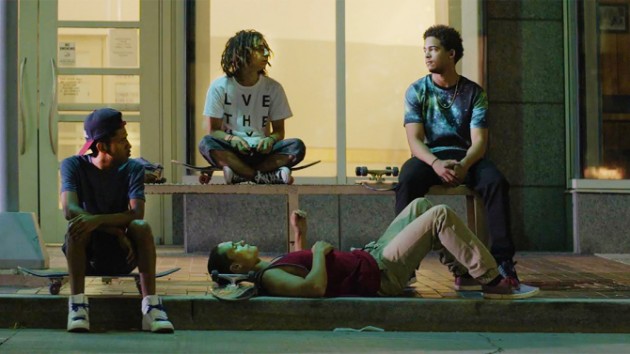
The Land centers on four chronically truant youths Patty Cake (Gavron), Boobie (Walker), Junior (Arias) and Cisco (Lendeborg) during their summer vacation. The four hope to escape their unforgiving neighborhood streets and third track expectations by stealing cars and raising enough cash to support a professional skateboarding career. By doing so however, they cross paths with one of Cleveland's most powerful drug syndicates and sink slowly into a life that may be too crooked for them to handle.

The Land follows all the similar story beats we have all come to expect, ever since Boyz n the Hood (1991) became an unexpected success. On the surface, the choices of our heroes are always clear in their truth and consequence, yet for whatever reason they're always stuck making the wrong choices at the wrong time. It can be cumbersome and by the third act it becomes wholly predictable. What an invested audience will see however is a slow motion car crash, where we know where all these little decisions are leading to, but are powerless to stop them.

That feeling of powerlessness permeates The Land, giving some a cause for contemplation. Even when the kids are goofing off, skating through blighted streets and abandoned school houses, you can just feel the tension; like the sudden woosh of air before a hammer drops. Cisco, the presumed leader of the gang insists "I don't want anyone to control me,"yet it's clear that he's being constantly molded, manipulated and controlled by an environment that's openly hostile towards him. That environment, by the way includes a manic Kim Coates whose crusty Uncle Steve would be considered Dickensian if he wasn't so outwardly pathetic. Between his uncle's ramshackle Hot Dog stand and his cousin Junior's house, Cisco gets the strong impression he's just another lost cause.

Seriously though, this is like the exact same movie...
What puts The Land just a hair above the average helping of faux-realist poverty porn is Caple's often poetic inclusion of Cleveland a not just a setting but a character in the film. Large portions of the film cast the city in eternal midnight; a Gothic harbinger of sorts. Yet when the four start selling large quantities of "Molly" to transient party-goers, the city opens up with predatory proficiency. The buses and Rapid Transit System are but mucky arteries, the buildings: a facade of wealth and wellness; the carnival hints at possible pleasures - yet it's all a lie.

While many films blunt their stories with overdone melodrama or social proselytizing, The Land dares to be bleak, telling a distressing story about the cyclical, cross-generational nature of political and economic violence. Taught to either accept vocational education for jobs that no longer exist, or live a short-lived life of wild despotism, these kids are never really given a chance. In a quest for self-determination, our crew all ultimately become servants of a larger master. It's the audience's embarras de choix as to whether any of them made the right choices.

Final Grade: C+

Tuesday, August 30, 2016

Don't Breathe

Year: 2016
Genre: Horror
Directed: Fede Alvarez
Stars: Jane Levy, Stephen Lang, Dylan Minnette, Daniel Zovatto, Emma Bercovici, Franciska Torocsik, Christian Zagia, Katia Bokor, Sergej Onopko
Production: Ghost House Pictures

Don't Breathe builds its tension the hard way. Instead of relying solely on jump scares and gore, the film consistently paints itself and its characters into a corner then creatively gets them out of a bad situation while being both unexpected and completely organic. It's a hard high-wire act and one that you'd think a genre director like Fede Alvarez would stumble on. Yet Don't Breathe not only continues the Hitchcockian chamber-piece Renaissance kicked off by Disturbia (2007), it runs away with it. It artfully repackages old-fashioned thrills and kills it with a third act that's ominous but earned.

Don't Breathe concerns the exploits of three white-trash miscreants named Rocky (Levy), Alex (Minnette) and Money (Zovatto). They live in post-bankruptcy Detroit, because horror producers find the scene of boarded up houses, blighted streets and deserted neighborhoods far too spooky to pass up. Plus with the average time for emergency response being 41 minutes, the pesky instinct to call the cops is left completely off the table. The trio are banking on this, in addition to Alex's family ties to a security company to rob houses with impunity. With one more score under their belts, Rocky and Money hope to move to California and escape their life of rust-belt entropy. Their target, a blind shut-in (Lang) whose recent court settlement made him a crotchety late-life millionaire. What the would-be thieves don't expect however is for their target to be so resourceful and so deadly.

Anyone familiar with Stephen Lang's filmography would know that the man has a long history of playing the grizzled tough guy and Don't Breathe's unnamed Blind Man is no exception. Despite having a little over ten lines and spending a large portion of the film wondering with arms out, he dominates the frame with muted bellicose. He's scary not only because he's a brutal close-range brawler but because his disability reminds us that he's still human. A human whose life has descended into a Nietzschean perversion - "Man can do anything, once he knows there is no God," he says in a moment of well-earned shock and disgust. 
When his humanity is questioned, in a second act reveal that steadily raises the stakes, our sympathies then ricochets back to our trio. Up until this point, were given the average wafer-thin backstories girdled with teenage neglect, alpha-male shows of dominance and unrequited love. Yet as the Blind Man becomes more invested in their demise and their routes for escape become limited, we as the audience feel for our teenage lambs; if for no other reason than we're right there with them. 

I won't go as far as to say, the characters have become fully formed by the time the credits roll, but I do admire their resourcefulness throughout. They deal with the claustrophobia of their plight with sharper and sharper fight or flight instincts complimented with masterful cinematography by Pedro Luque. His camerawork allows the audience to truly immerse themselves in the space, keeping us glued to not only the characters but what their seeing...and more importantly what they're not seeing.

If there's a spiritual grandfather to Don't Breathe it's almost certainly Alfred Hitchcock's Rope (1948). Not only is the cinematography eerily similar but so are the themes which parities feeling of superiority (in this case moral not intellectual) with the banality of evil. 10 Cloverfield Lane (2016) may have been this year's torchbearer for the old master's brand of suspense thus far this year but I'm going to go ahead and say its reign has been short-lived. Don't Breathe - don't miss.

Final Grade: B-