Sunday, October 16, 2016

Max Steel

Year: 2016
Genre: Superhero Film
Directed: Stewart Hendler
Stars: Ben Winchell, Josh Brener, Maria Bello, Andy Garcia, Ana Villafane, Mike Doyle, Phillip DeVona, Billy Slaughter, Al Mitchell, Lawrence Kao, Brett Gentile, Jahnee Wallace
Production: Dolphin Entertainment

Make no mistake, Max Steel, the Mattel toy property, turned Cartoon Network staple, turned full length movie has become the worst reviewed wide-release film of 2016. After a single weekend, the movie has garnered a staggering Metascore of 26, and a 0% on Rotten Tomatoes. Those are scores usually reserved for direct to DVD video game adaptation and the occasional Pauly Shore movie. I'll admit with so many metrics stacked up against it, my interest both as a critic and a connoisseur of junk cinema was piqued. I wanted to hate this movie; I came in with the expectation that this movie was a special kind of crappy. But alas it's just the regular kind of crappy.
My grandma holding up Zoolander 2 on Blu-Ray
The plot of Max Steel promises the adventures of a middle-America teenager named Max (played by perennial kids-TV bit-player Ben Winchell) and his alien companion named Steel. Due to Max's seemingly inexplicable ability to conjure energy on a molecular level, Steel acts as a symbiotic techno-parasite consuming it with relative safety. In return, Steel (voiced by Josh Brener) enhances Max's physical abilities and protects him with a laser spewing bio-tech suit. Little does Max know that his new friendship with his alien buddy upsets a certain celestial balance, that holds the future of our world in the hands of a sinister enemy.

Andy Garcia's Career: 1978-2016
The plot promises these things but in an election year, we should all be wary of false promises by now. While watching Max Steel I was less concerned about the fate of the world than the fate of those involved in this project and made the mistake of taking it seriously. The film co-stars award nominated actors Maria Bello and Andy Garcia whose natural gravitas threatens to give Max Steel more weight than your average Smallville (2001-2011) knockoff. I understand that veteran actors need to eat but most actors should draw the line when asked to put on a half-assembled Power Rangers outfit.

The film itself is a cheap, shabby, impotent mess that tries oh so hard to ape the grungy self-serious aesthetic from recent superhero fare. But instead of finding a balance between pretension and moment-focused excess, the camera diddles through colorless scenes that look like they were shot through a layer of cellophane and Vaseline. This of course is when we get exteriors of antique pickup trucks chugging through amber-waved back-roads. When it comes to the heavy climaxes, the movie seems poised to give us the same blighted industrial zones we've seen in everything from low-budget horror movies to late-period Steven Seagal flicks. Only this time it's lighted like a neighborhood Zap-Zone to give the film's target audience (mainly toddlers and their misguided gamgams) the desire to whip out their video games.

It's all so genuinely and quite unpleasantly sad to see a movie like Max Steel. Watching bloated, intelligence insulting, big-budget fare fall flat can give anyone a sudden jolt of schadenfreude. Yet watching something whose only real crime is being too big for its britches, well it's just not that much fun. The film and its makers are trying to mimic a certain style, a certain flow, a certain spirit yet it simply have none of the right tools to do so. So they patched this puppy up with as much exposition, flashbacks and Josh Brener inspired wisecracks to trick you into thinking it was all worth it. But it's not, it's really, really not.

Max Steel is like going to the zoo, visiting the tiger exhibit and seeing a tiger born and raised in captivity. Many people arguably worked their best on this film, but because their best is inspired by the limited cultural echo chamber of comic books, blockbuster movies and Halo, we get a movie that lazes about, the fierceness in its eyes completely absent.

Final Grade: F

Tuesday, October 11, 2016

The Girl on the Train

Year: 2016
Genre: Drama
Directed: Tate Taylor
Stars: Emily Blunt, Haley Bennett, Rebecca Ferguson, Justin Theroux, Luke Evans, Edgar Ramirez, Laura Prepon, Allison Janney, Darren Goldstein, Lisa Kudrow, Rachel Christopher, Lana Young
Production: DreamWorks SKG

I feel the need to defend this film a little bit (not a lot just a little). Story-wise it has the same bemusing melodramatic tone, shifts in perspective and twist-turny moments that set the foundation for Gone Girl's (2014) moody atmospherics. Much like that film, our leads, a triumvirate of Emily Blunt, Haley Bennett and Rebecca Ferguson, do very well as sympathetic characters audiences are willing to hang their coat and hat on for two hours. The editing shuttles back and forth in time, patching in layers of information to give us conclusions where it once was hazy. So what's actually missing here?
Quite a lot as it turns out.
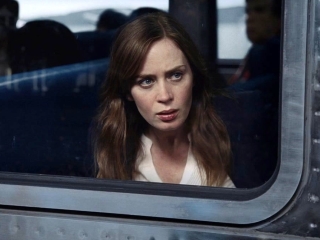
As you would imagine, the film begins with a girl on a train. The girl is Rachel (Blunt), an unemployed, severe alcoholic, who watches from the third car of the Manhattan bound train as the trees and nearby houses fly by. She seems keen on one such house, one belonging to the lovely Megan (Bennett) and her muscular beau Scott (Evans). She imagines them a young couple in love living in marital bliss, unaware that Megan is, in-fact a frustrated former art gallery assistant who babysits for our third protagonist Anna (Ferguson) and her husband Tom (Theroux). Completing the social circle, we're soon made aware that Rachel was once married to Tom...a fact made painfully aware when Megan winds up missing and Rachel becomes suspect #1.

The Girl on a Train coyly treads lightly while introducing us to all of the story's moving parts. The seed of suspicion are planted in nearly everyone involved, including our main audience conduit Rachel, who suffers from episodes of blackouts. Even Megan, whom we've come to know as free-spirited and oversexed, gives us the impression that her disappearance is her merely wanting escape. With so many balls in the air, the film is poised to keep us just that much in the dark until plot-points finally chime in.

This is either a sign of a great mystery or a movie hiding the fact that it has little to say. Those suspicions are certainly not helped by Rachel's constant memory lapses which disappear only when the story need them to. Once of course we get into the final act, everything is made clear not by virtue of a collage-like narrative or clever visual foreshadowing but because Rachel suddenly remembers something which holds the key to everything.

As Rachel, Blunt deserves accolades for her portrayal of the ultimate victim in a plot dominated by characters who despise her. Her character arc, (a salvation through fortitude-type conclusion) fails to really gel with the film's machinations. But at least through her, it has the appearance of being earned. There are times I really wished there was more to her; a pulpy anti-hero angle just this side of Ray Milland from The Lost Weekend (1945). Unfortunately because she has to share screen time with the two other main women, not to mention a host of nefarious men, all we get is an alcoholic who'd only get better if she stopped playing into the "crazy ex" cliche.

Thankfully this film is trying to say something more than just "here's a good yarn". There's been a bevy of new "women's films" over the last few years that stretch out of genre comfort zones to tackle worthwhile themes. Themes as current as workplace discrimination (Equity (2016)), body-shaming (Spy (2015)) and misogyny (Mad Max: Fury Road (2015)). While I don't think shining the light on physical and emotional abuse excuses this particular film's many shortcomings; those teetering on whether or not they should see Girl on the Train may see a selling point here.

As far as movie adaptations of mystery novels, written by women, loaded with red herrings, tinged with pop-psychology, brimming with unreliable narrators, jumps in time and an overall cynical view on love, Gone Girl is a much better film. Yet don't count out Girl on the Train simply because it's always painted with the same brush. There's a little something more to this film than it being just a mimic.

Final Grade: C

Monday, October 10, 2016

Miss Peregrine's Home for Peculiar Children

Year: 2016
Genre: Fantasy
Directed: Tim Burton
Stars: Eva Green, Asa Buterfield, Samuel L. Jackson, Chris O'Dowd, Terence Stamp, Ella Purnell, Finlay MacMillan, Judi Dench, Rupert Everett, Allison Janney, Lauren McCrostie, Georgia Pemberton
Production: 20th Century Fox

Despite seeing this film more than a week ago, I have been avoiding reviewing it. Not because it is a particularly loathsome film or because it's a particularly big disappointment. To put it simply there is very little to say about Miss Peregrine that hasn't already been said. Everything about the film is basically spelled out in the trailer and despite having a name-brand director whose history of odd images usually has some kind of merit to it, Miss Peregrine remains, to put it bluntly unpeculiar.

The film is based on a trilogy of time-travelling young adult novels written by Ransom Riggs. We follow our seemingly normal protagonist Jake (Butterfield) as he traipses through "time-loops" to uncover the mystery of his grandfather's death. While doing so he comes across Miss Peregrine's Home for Peculiar Children which smuggles its young wards into these time-loops to protect them from villains, ne'er-do-wells and the odd muggles. Jake must then face off against a plague of invisible villains all while trying to convince his father (O'Dowd) that he's not completely off his rocker.

This all sounds suspiciously familiar...
As to be expected from the studio that continues to churn out X-Men (2000-present) movies, Miss Peregrine spends an awful lot of time building it's world and painstakingly maintaining it throughout the course of the film. Time-travel can be a cruel, timey-wimey thing concerning story structure thus watching the film beam-balance over the usual pratfalls is a wonder all it's own. Especially given the fact the movie crams in two out of three books into a single 2-hour film, I'm amazed nearly nothing collapsed in on itself.

Yet the movie not stretching into a mobius strip up its own a** is about the only thing really worth celebrating about Miss Peregrine. The acting is serviceable, the cinematography and special-effects are just north of Alice in Wonderland (2010) (no matter how many Jason and the Argonauts (1963) references you add to it) and the themes are right there in the pudding. It's a straightforward heroes-tale that fills the screen with old-fashioned, morose filigree. The kind that would have made the Tim Burton from twenty-years ago the obvious choice to helm the project. Yet like Rip Van Winkle, Burton seems to have just woken up and is unaware that Harry Potter, (2001-2011) The Hunger Games (2012-2015), The Maze Runner (2014-Present), The Divergent Series (2014-Present), Narnia (2005-2008) and Percy Jackson (2010-2013) already exist.
...let alone the iPhone 7

It's clear the studio was aware these properties exist, and seeing no future for this particular franchise; 20th Century Fox in their all-seeing wisdom decided to cram most of the Peculiar Children trilogy into one characterless film. It's a shame too because the story has so much to setup. So much that, when the inevitable book jump rears its ugly head, the gear change is enough to give any unsuspecting audience member whiplash.

If anyone were to benefit from further movie installments it arguably could have been the villains led by Samuel L. Jackson. Their plan, ambitions and all-around look (somewhere between the monsters of Resident Evil and a brood of Hot Topic fans) could have morphed into something interesting if given a wider birth. Unfortunately their purpose in the movie we got is just so perfunctory. That and their menace is totally undone by zany pranks that feel like they were rejected from Home Alone (1990).

Miss Peregrine works in pieces and if taken out of context of being done before so, so, so many times before, it kinda stands on its own. Yet if ever there was a poster-child for the common phrase "the book was better," this movie is certainly it.

Final Grade: C-

Tuesday, October 4, 2016

Masterminds

Year: 2016
Genre: Comedy
Directed: Jared Hess
Stars: Zach Galifianakis, Kristen Wiig, Owen Wilson, Jason Sudeikis, Kate McKinnon, Leslie Jones, Mary Elizabeth Ellis, Ken Marino, Devin Ratray, Jon Daly, Allegra Nova, Jill Jane Clements, Daniel Zacapa
Production: Relativity Media

Welp, it looks like the dunderheads at the now bankrupt Relativity Media LLC. Are hell-bent in giving us yet another doozy before the year’s end. What kind of rightfully shelved prattle do they have for us to mull over and regret buying a $10 ticket for this week? A Zach Galifianakis helmed caper comedy about a love-struck loser turned armored truck robber, co-starring Kate McKinnon, Kristen Wiig and Owen Wilson? That doesn’t seem so bad.
Directed by the same guy who made Gentlemen Broncos (2009)...s**t!
Well it gets bad folks, real bad. The kind of bad that gives even the most forgiving audience the urge to check their messages before sneaking into Storks (2016) to “check on the kids.” Masterminds is an unholy mix of good ideas and concepts made painfully unfunny due bad editing, sloppy storytelling and an over-reliance on the same-old ugly American jokes not funny since Bush was in the White House.

The bang adorned Galifianakis plays David Ghantt, a trailer park doofus whose job as an armored car driver fills his head with notions of tense Mexican standoffs and Lee Marvin inspired bravado. His regular partner Kelly (Wiig) passively encourages his flights of fancy, joining him at the shooting range for target practice and openly discussing what she’d do if she was Phillip Johnson; a Loomis Fargo employee that tried to run off with $18 million. Convinced by Kelly’s womanly charms and a heist plan masterminded by Kelly’s friend Steve Chambers (Wilson), Ghantt decides to follow directives to steal the cash from the Loomis Fargo vault and run off to Mexico for a lovers’ rendezvous.

On paper, Masterminds has a decent amount going for it. The movie’s story attracted quite a few members of SNL’s (1975-present) present star lineup including Kate McKinnon as Ghantt’s awkward wife, Leslie Jones as the fussy lead FBI investigator and Jason Sudeikis as a frightfully obtuse hitman. The film is directed by Jared Hess the man responsible for bringing deadpan anti-humor into the mainstream with Napoleon Dynamite (2004)…so clap if you’re into that. Mix in Galifianakis’s personal brand of cringe-antics and Owen Wilson’s inference to his character in Bottle Rocket (1996) and you got yourself quite a lot to root for.


Unfortunately, this film is much like a foul smelling casserole made with biscuits, Funions and eight-year-old Velvetta; individually each component sounds appetizing enough but clumping all these things together creates a slurry of colon clogging flotsam. The stranger than fiction tale of the Loomis Fargo robbery could have been, should have been a movie about class dispossession. Lacking that, it could have scored some points simply by dialing up the wacky. Yet Hess's inability to graduate his images from weird to laugh-inducing, mutes the good stuff from hitting its proper frequency. Nowhere is this more clear than when Galifianakis dons bad disguise after bad disguise in order to "blend in".
Everyone in this film shamelessly acts out their best Joe Dirt (2001) impression, likely enjoying each other's company to the detriment of the audience. In so doing, they come up with no funny lines or endeavor to make their characters anything more than poorly defined caricatures. The film then pads the narrative's plot-points to the brink; insuring whatever tiny morsels manage to get a giggle remain few and far between. By the time the robbery takes place (a mire half-hour into the film), all humor has ceased and all opportunities for humor have long choked on the lack of oxygen,

In a confounding moment of stupidity, Ghantt fumbles into the back of his armored truck and locks himself in, just as he's getting ready to leave. Seeing Ghantt panic and struggle to breathe at that moment is in many ways the perfect metaphor for this film. Clustered, confused, angry with himself and shambling to find the gears in the next compartment, Ghantt, like the audience feels stuck in a situation that should have never happened. This movie should have never f***ing happened.

Final Grade: F

Monday, October 3, 2016

Queen of Katwe

Year: 2016
Genre: Drama
Directed: Mira Nair
Stars: Madina Nalwanga, David Oyelowo, Lupita Nyong'o, Martin Kabanza, Taryn Kyaze, Ivan Jacobo, Nicolas Levesque, Ronald Ssemaganda, Ethan Nazario Lubega, Nikita Waligwa, Edgar Kanyike
Production: Walt Disney Pictures

Queen of Katwe is a happy marriage between inspirational underdog sports movies and maudlin feel-good success story cliches; churned into velvety, buttery food for the soul by Disney's well-oiled dream machine. That may come across as a put down but I assure you the greater ends of this film are admirable enough on their own merits to shoulder its various cliches, and dully earns its moments of tears. You may have seen a version of this before, but like a cherished Sunday hymn, Queen of Katwe is familiar in all the right, comforting ways.

The true story of Phiona Mutesi (Nalwanga) begins in the Ugandan slum of Katwe. Due to an unexpected death in the family, Phiona, her older sister Night (Kyaze) and younger brother Brian (Kabanza) were taken out of school to help their tenacious mother (Nyong'o) sell maize on the streets. As a result Phiona is functionally illiterate and quickly faltering under the weight of life's hardships. One day, intrigued by the smell of porridge and the laughter of other children, Phiona and Brian stumble into Robert Katende (Oyelowo) Sports Outreach Program. It is there, among other things the trained engineer teaches chess to interested children with hopes of putting rich kids in their place. After a time, the spirited Phiona develops a hidden talent and passion for chess which Katende encourages to the point of training her to be a tried and true prodigy.

Who's ready for some chess?!
Arguably the most striking thing about Queen of Katwe is just how seamlessly the static game of chess lends itself to comely sports dynamics. While not exactly pulse-pounding - the only film to my recollection that made chess truly cinematic was Searching for Bobby Fischer (1993) - the spirit of competition instilled in Katende's group sets in motion many tiny setups and payoffs. The David versus Goliath staging of the chess matches crackle with anticipation, much like watching the wick of a firecracker moments before it begins to hop. As Phiona gets more serious about her goals of becoming a Chess Olympiad champion, so too do the matches. The opponents become less foolhardy and more calculated only serving to make the scenes more intense. This is despite the camera wanting to linger on grimaces instead of rooks and bishops.

Yet the film's intention isn't to make chess interesting in and of itself. It's goal is to make Phiona's underdog tale the focal point. In that regard, we're treated to a cautious yet effective examination of a slum kid turned African champion, made a hair better than usual, by director Mira Nair's surgical approach to the story. While Nair rests a bit too comfortably on her laurels as a humanist for hire, there's no debating her ability to infuse life into every frame. Queen of Katwe is awash in color, brimming with energy and ably wins even the most cynical among us with effervescent glee.

Still one of the best underdog stories of all time.
The other side of that effervescence of course is the young Madina Nalwanga whose discovery ranks up there with Keke Palmer in Akeelah and the Bee (2006). The largest stumbling block of the movie; an extended tangent about hubris that goes nowhere, actually morphs into a proving ground for the young actress. She proves not only that she can be a child actor but a child actor with range even while the film feels like its slowly deflating.

Then of course there are the ample talents of David Oyelowo and Lupita Nyong'o to consider. As Katende, Oyelowo is solid as the kindly mentor the kids all call Coach. The script pigeonholes the character to the tune of a saintly mentor beyond reproach; thankfully Oyelowo plays a few new chords out of that old ditty. Yet while Oyelowo glitters, Nyong'o shines as a tough-as-nails single mother whose seen it all. When it comes to taking hardship with a noble sense of courageousness, her Harriet does all the emotional heavy lifting and carries it through with aplomb.

Somewhere in the middle of the film, an official observes that Phiona's strategies on the board are the most aggressive she's seen from a girl. Secretly I was hoping the film would have taken just as many bold risks. Fortunately thanks to the vibrant mis en scene and three excellent performances by our main cast, Queen of Katwe succeeds in being the heart-warming crowd-pleaser it was designed to be. I suppose there are worse things to be in the world than that.
It could have been this trainwreck...

Final Grade: B-

Sunday, October 2, 2016

I Drink Your Blood

Year: 1970
Genre: Horror
Directed: David E. Durston
Stars: Bhaskar Roy Chowdhury, Jadin Wong, Rhonda Fultz, George Patterson, Riley Mills, John Damon, Elizabeth Marner-Brooks, Richard Bowler, Tyde Kierney, Iris Brooks, Alex Mann, Lynn Lowry
Production: Jerry Gross Productions

I Drink Your Blood is the genuine article in a certain sense. Sure for the uninitiated, the film is just another low-budget 70's oddity but to true horror connoisseurs it's the kind of schlocky, late night treat that greased the late-fee wheel of many a video-rental shop. It's the kind of bizarre outlayer that guys in their thirties sandwiched in-between innocuous titles and backroom porn to not look like some kind of weirdo. Made for next-to-nothing and saying more than most, this little exploitation flick just may be the perfect example of "so bad, it's good."

The film is centered on a cabal of Satanic hippies who descend on a small town in upstate New York. After causing considerable panic among the townsfolk (in reality, like five people), the hippies find themselves victims of a revenge plot involving meat pies infected with rabies. Instead of killing them however, the pies turn them into quasi-zombies with a lust for blood and chaos. Can the survivors lead by bakery owner Mildred (Marner-Brooks) and wayward teen Sylvia (Brooks) survive?

Much of the film's unintentional hilarity ensues with the constant presence of Bhaskar Roy Chowdhury's Horace, the leader of the group. Something of an analog of Manson Family, Horace's group is glued to his hip due to what should come across as wide-eyed charisma. Yet his wild gesticulations and off-kilter roguishness is so over the moon that he highhandedly derails the film within the first frames. From that point on, it's no holds barred as to where the movie is going and with whom.

Or why for that matter, the characters are so poorly developed and simperingly stupid that there's nothing for us, the audience to anchor ourselves to let alone sympathize with. The editing is simultaneously the best and worst aspect of this film. Best because it snaps back and forth between groups of people so quickly that it's impossible to get bored. Worst because so much is built up only to be left by the wayside while certain payoffs seem to come out of nowhere. There's shock but no awe and then awe lacking shock. It's as if we're reading the journal of a lunatic yet the journal has been partially burned in a basement furnace.

To give credit where credits due, the film ably cash in on the perceived evils of drugs, free love, cross-racial integration, Vietnam anxiety and teenagers run amok. Then in an act of frightening forethought director David E. Durston married those fears with overt and unabashed devil worship pre-dating the satanic panic of the 1980's. While I won't go so far as to say I Drink Your Blood caused such cultural overreaction and hysteria, the film did ride a pretty big wave of 1970's exploitation films concerning our relationship with a certain dark master.
What the literal hell 1970s!
Yet if you're looking for cogent social commentary from the bloodied, drooling maws of an exploitation film like I Drink Your Blood, you might just be connecting dots that aren't there. As it is, this 1970 gorefest is a garbled mess made memorable only because its too inept to be taken seriously and too frenzied to be boring.

Final Grade: F

Saturday, October 1, 2016

Deepwater Horizon

Year: 2016
Genre: Drama
Directed: Peter Berg
Stars: Mark Wahlberg, Kurt Russell, Gina Rodriguez, John Malkovich, Dylan O'Brien, Kate Hudson, Ethan Suplee, Henry Frost, Jeremy Sande, Brad Leland, Joe Chrest, Douglas M. Griffin, David Maldonado
Production: Summit Entertainment

Call the month of September gear shift month for big-budget Hollywood. Somewhere just before school begins and the auspicious start of award season, larger outfits worth their salt release otherwise decent films that don't quite fit neatly into the defined high and low tides of Blockbuster season and Oscar-bait season respectively. Sometimes that's a good thing, giving us underappreciated gems like Pawn Sacrifice (2015) or out-of-nowhere emotional powerhouses like Room (2015).

This month, the movie Gods have blessed us with not one, but two nuts-and-bolts features, based on true, ripped from the headlines stories existing as examples of American selflessness and elbow-grease, but whose movie adaptations prove underwhelming. The first was Sully (2016); now the second is Deepwater Horizon.

In the wee hours of April 20, 2010, the Deepwater Horizon, a semi-submersible offshore drilling rig exploded 40 miles off the southwest coast of Louisiana. After the initial catastrophe, 126 workers found themselves trapped aboard the rig which was quickly consumed by a raging fire that lasted more than 24 hours. The film centers on the stories of the 126 crew members and their challenges to escape danger in the explosion's immediate aftermath.

These stories include that of Chief Electrician Mike Williams (Wahlberg). The beginning of the film portrays him as a blue-collar every-man whose expertise and caution pegs him as one of the main flies in the ointment to impatient company men. When he first arrives on the Deepwater, he and rig foreman Mr. Jimmy (Russell) appropriately ream BP overseers for ignoring (among other things) a leaky blowout preventer, an untested wellhead and, most egregiously calling back the exploration crew before they could test out their concrete job.

If that all sounds too technical don't worry, director Peter Berg seemingly unaware that audiences can pick up on context clues, plugs in handy title cards to help explain the intricacies of drilling for oil on the open seas. Information that cannot be conveyed via tile card is helpfully scribbled on chalkboard by main BP lackey Donald Vidrine (Malkovich) and surmised by Russell's "working-man knows best" proclamations. This is despite knowing full-well, the Deepwater's crew presumably knows how to do their job.

In fairness to Mr. Berg, the technical abilities of an oil rig crew is a pretty insulated set of engineering expertise. A profession whose lingo doesn't quite lend itself to an audience like a writer or lawyer or airline pilot does. It's even more of a wonder the movie is as harrowing as it is when you consider Berg's recent pivot from being a poor man's Michael Bay to a pretty convincing mimic of Paul Greengrass. Only the arrival of Patriots Day (2016) will confirm if that transformation is complete but as of now his mimicry remains sorely undercooked.

Part of the problem is an inability to marry subject with scale. Berg likes to play it tight with his camera, focusing on frenzied in-frame movements, microcosmic gear-churning and bloodied wounds instead of the grandeur of a gigantic rig lighting up like Burning Man. Despite there being a concerted attempt to explore every nook and cranny of the Deepwater, when s*** really hits the fan, you're never quite sure where you are or where the characters are in relation to one another.

Seriously, just look at that mustache!
What's worse, there's also no time for character in Deepwater Horizon. There's a sense of peril but every time a poor soul gets engulfed by flames, we're never clear on who exactly is in peril, or why we should care. Only Russell and Wahlberg get the chance to emerge from the grime and grease as recognizable faces. Russell in particular is pegged early by virtue of a pretty nice face caterpillar; that and a performance that perfectly captures the zeitgeist of gruff and grizzle we truly need.

As our default protagonist, Mark Wahlberg is given every chance to display his personal brand of everyman heroics. He's basically played the exact same character in Berg's much better Lone Survivor (2013), where he was able to mix aspects of his natural masculinity with his inner Tony Robbins. Here however he's sabotaged by an innocuous presence, slurred speech and indecipherable jargon. I'm sure in a film script less tethered by the limitations of docudrama realism, he could have made it work. Unfortunately oil rig electrician is simply another STEM field job Markie Mark just isn't suited for.
I can science, I have scienced before...
We all guessed The Perfect Storm.
Despite it's many faults however, Deepwater Horizon is an okay movie made just a smidgen more relevant by its real-life story and the fact that it's September and there's not all that much out at the moment. Watch it, enjoy it, and realize that five years from now you'll probably get a question about it at your local tavern's trivia night and get it wrong.

Final Grade: C