Tuesday, January 21, 2014

The Americanization of Emily

Year: 1964
Genre: Comedy
Directed: Arthur Hiller
Stars: James Garner, Julie Andrews, Melvyn Douglas, James Coburn, Joyce Grenfell, Edward Binns, Liz Fraser, Keenan Wynn, William Windom, John Crawford
Production: MGM

Paddy Chayefsky should be a well-known figure to modern cinema aficionados. Not only did he accurately predict tabloid TV journalism in Network (1976), our dysfunctional healthcare system in The Hospital (1971) and Clint Eastwood’s psychosis in Paint Your Wagon (1969), he was also nominated for a Best Writing Oscar four times, winning three of those times. The only other person with more Screenplay prowess and a tied record is the brilliant Woody Allen.

War man...it's so, like, whoa!
Even less attention is given to his Middle of the Night (1959) follow-up The Americanization of Emily (1964) a movie so pitch black and anti-war that I’m surprised there weren’t riots in the street at the movie’s premiere. Though I suppose in a year that gave us Dr. Strangelove (1964), Fail-Safe (1964) and the Gulf of Tonkin incident, a movie about a self-professed coward avoiding war isn’t entirety out of place. Is it safe to say that Chayefsky also predicted Vietnam protests?

The Americanization of Emily starts with a cheeky dedications to dog robbers i.e. adjutant Lieutenants whose job is to procure luxury goods and other treasured items for high-ranking officers. Lieutenant Commander Charlie Madison (James Garner) prides himself as the best of the dog robbers and dutifully manages and preens the not entirely commonsensical Admiral Jessup (Melvyn Douglas). Emily Barham (Julie Andrews), a British subject and motor pool driver is at first disgusted by his demeanor and sybaritic lifestyle but grows to like and fall in love with him.


Oh hell no!
With D-Day quickly approaching, Admiral Jessup has become preoccupied with the U.S. Army’s Air Corps overshadowing his sailors and the Navy. Seemingly in a daze, the Admiral looks to make a movie showing the first dead man on Omaha Beach to be a sailor and he recruits Madison and his Spartan friend Bus Cummings (James Coburn) to do the filming.

Perfectly content with a life of cowardice and alarmed at the logic behind his mission, Charlie pulls off all the stops to keep him out of harms way. His behavior puts him at odds with Emily, his friends, his superiors, nearly everyone who comes in contact with him. Yet Charlie is far from a weak ineffectual character. He positively exudes cynicism and opportunism as if it was engrained and as a result it’s hard not to like him. In fact, his justification for his yellow streak is near-noble. “War isn't hell at all. It's man at his best; the highest morality he's capable of…it seems we'll have to destroy all of man in order to preserve his damn dignity. It's not war that's unnatural to us, its virtue. As long as valor remains a virtue, we shall have soldiers. So, I preach cowardice. Through cowardice, we shall all be saved.” Wow; and that at a time when we were fighting Adolf Hitler.
I'm sure this guy would have been very
receptive to the whole no war thing.
Yet The Americanization of Emily isn’t about WWII, it’s about all war in general and indicts everyone from the Generals who make the decisions to the widows at home who sanctify the valor of a soldiers sacrifice. It’s a screenplay that emanates pure bile yet can’t help but be savored by the pessimists in all of us. It also helps that the movie as a whole is hilarious.

The anti-Mary Poppins. Just look at that frown
That and the film relies on the romance between Charlie and Emily to sweeten the bitter pill. In the first few scenes Julie Andrews plants herself as a capable and immediately likeable actor capable of absolute magic. Released the same year as Mary Poppins (1964), The Americanization of Emily presents Andrews as a polar opposite of Poppins. She’s no shrinking violet and certainly not a magical nanny who nourishes children with spoons full of sugar. She can be downright cold in Emily; cold yet relatable.

Also worth mentioning is the work of James Coburn as Charlie’s friend who only because of nearsightedness cannot join the war effort. He feels he might makes up for it by volunteering for the mission to make propaganda and pushes Charlie to do the same to the point of madness. Yet he isn’t beyond bedding amiable British women and taking full advantage of his “disability” and connections. In addition Melvyn Douglas’s performance as the senile Admiral, whom Charlie keeps, is a little unbelievable at times but nevertheless is pretty entertaining.
Chayefsky was hipster before it was cool
The Americanization of Emily is a subversive cinematic gem that arraigns the entire idea of war by highlighting inefficiencies, hypocrisies, inadequacies and downright lunacies (not to mention the horrors of real actual fighting). Paddy Chayefsky died in 1981 after being diagnosed with cancer leaving a legacy of superb films, TV programs and literature. A true cynic until the end, he refused treatment due to fear of retribution by doctors who saw The Hospital. Not since Diogenes of Sinope was there a man like Chayefsky nor will there ever be another for a good long time.

Final Grade: A

Monday, January 20, 2014

Beyond the Law

More of an Oregon fail
Year: 1968
Genre: Western
Directed: Giorgio Stegani
Stars: Lee Van Cleef, Antonio Sabato, Gordon Mitchell, Lionel Stander, Bud Spencer, Graziella Granata, Herbert Fux, Carlo Gaddi, Ann Smyrner, Enzo Fiermonte, Hans Elwenspoek
Production: Roxy Films

Contrary to popular belief, the American west wasn’t some lawless prairie/desert where only the strong like John Wayne’s Rooster Cogburn and Clint Eastwood’s man with no name could survive. While the likes of Jesse James and Butch Cassidy made the headlines, the average day in the life of an American westerner was actually pretty dull. The majority of people who lived west of the Mississippi lived in urban areas, not out in the boonies. Gun violence was actually less common in the western territories than back east and the majority of those who went out west were first generation immigrants, not idealistic white folk provoked by the call for manifest destiny. Beyond the Law (1967) is a movie that may not dispel the myths of the wild, wild west, but like many Spaghetti Westerns it does put a new spin on things.

Lee Van Cleef stars as Billy Joe Cudlip, a craven thief who steals the payroll of a mining community from a naïve Czechoslovakian payroll clerk named Ben (Antonio Sabato). He is of course helped by his gang of thieves and conmen, Preacher (Lionel Stander), who dresses like his name to get rubes to trust him and James (Bud Spencer) a black man with a friendly face. Things go according to plan until Billy befriends Ben and is shoved into helping the locals recover the money. Preacher and James see this as an opportunity to steal more loot but things get further complicated when a rival gang of thieves led by Burton (Gordon Mitchell) comes into town.

Gosh a lot of people announce their name in westerns!
Now Beyond the Law is far from a perfect movie. The acting ranges of the supporting characters range from okay to terrible and the cinematography is simplistic. Directed by Italian director Giorgio Stegani, Beyond the Law or The Good Die First brings to mind less severe Spaghetti Westerns. Rather than go the path of A Fistful of Dollars (1964), Stegani and his international crew made a movie closer to My Name is Nobody (1973) and My Name is Trinity (1970). It has the tendency to be funny and even unintentionally goofy at some points with Lee Van Cleef showing he can make the best out of a paycheck that bills him with non-English speakers.

If you’re a western buff who’s easy to please then Beyond the Law may be a perfect little surprise for you. It’s a movie that is comfortable in its own banality. The story itself is strong, partially written by prolific Italians writers Mino Roli and Fernando Di Leo and the feel of the film is small but unique. The film was made only a year after Van Cleef’s appearance in The Good the Bad and the Ugly (1966) and helped make Bud Spencer a star in his own right. It should at the very least be considered a decent B-movie.

There are worse movies you can watch

If you’re interested, try finding the 105 minute version through Diamond Entertainment and look to avoid imitators with bad digital transfers. There is a colorless butchered version that you can likely find at a bargain bin somewhere and there’s a decent letterbox version you can find online. Go check it out before the ghost of Red Ryder comes back to re-mystify the west.

Final Grade: C

Sunday, January 19, 2014

Frozen

Year: 2013
Genre: Animated Musical
Directed: Chris Buck, Jennifer Lee
Stars: Kristen Bell, Idina Menzel, Jonathan Groff, Josh Gad, Santino Fontana, Alan Tudyk, Ciaran Hinds, Chris Williams, Stephen J. Anderson, Maia Wilson, Edie McClurg, Maurice LaMarche
Production: Disney Studios

Disney princesses really seem to be on the upswing these days. With 2010’s Tangled making a splash and Pixar’s Brave (2012) doing it’s thing, not only does there seem to be a resurgence in Micky Mouse regality but it’s one of a different stripe. Gone are the days when Jasmine was saved from the clutches of Jafar by Aladdin (1992) and the smart but naïve Ariel from The Little Mermaid (1989) was saved by Prince Eric. These girls are here to kick ass and take names and to that I say it’s about damn time.

Do we look like we need a man?
It started with The Princess and the Frog’s (2009) Tiana. Sure she ends up with her undeserving lothario noble but the principle lesson in The Princess and the Frog is you got to forge your own success, no one else is going to do it for you. Female independence wins out; hazah! Then along came Rapunzel in Tangled; at first a little too bubbly for my taste and she did marry the hero who came to save her, but she saved him via tear. Not exactly a women’s lib lesson but at least she saved him and not the other way around. Then Brave completely changed the game by ignoring the love angle altogether, focusing on a mother daughter relationship and a woman’s intent on making her own way in life.

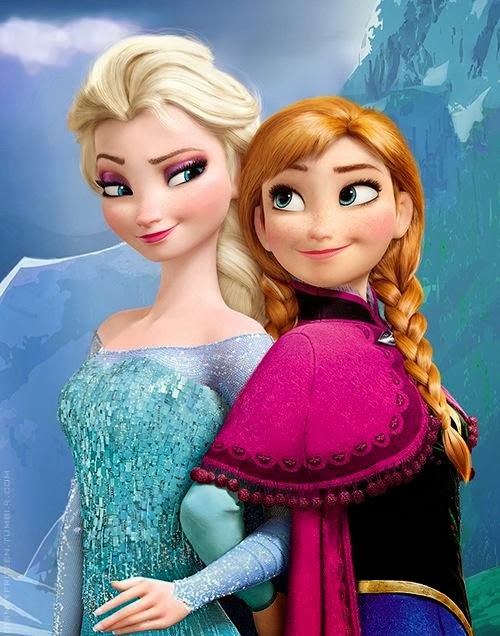
Now we come to Frozen (2013), a movie that once again challenges the assumptions of old Disney in favor of a more liberating storyline. Elsa (Idina Menzel) and Anna (Kristen Bell) are two princesses who live a sheltered life in their palace. The gates almost never open for good reason as Elsa has the power of frost and freezing she cannot control. She keeps it a secret to almost everyone including her spitfire sister. But after their parents die and Elsa is coroneted Queen, The gates open and Anna is introduced to her prince in shining armor (Santino Fontana). Elsa objects to a sudden marriage proposal and inadvertently unleashes her power. While Elsa chooses to hide away in the mountains, Anna vows to return her to the throne and put an end to their kingdom’s eternal winter.

Of course on her journey, Anna discovers colorful friends including a gruff mountain man named Kristoff (Jonathan Groff), his trusty reindeer Sven and a magical snowman named Olaf (Josh Gad). And when things get rough and Anna’s prince turns from kind to Kind Hearts and Coronets (1949), the one thing that makes the whole ordeal worthwhile is true love right? Well in a way.

If you want to know more about how Frozen brazenly walks the path set by recent Disney and newer animated features in general you’ll just have to watch it. Let’s just say that Frozen does have a lot of strong themes that challenge viewers young and old without being cruel and cold. The detail in the animation is breathtaking and almost everything works about this film.

If Frozen has faults they’re similar to that of Tangled. Both make the choice to be musicals which isn’t inherently a bad thing but there is a standard to reach. Unfortunately while songs like Let it Go and Do You Want to Build a Snowman are superb, the soundtrack as a whole just doesn’t reach the apex of Disney classics like The Lion King (1994) or Beauty and the Beast (1991). Additionally there just seems to be a staggered way the songs are infused into the story. Some you see coming while others just kind of pop out at you. Sorry but if I had my choice I want a little warming up before you come barging in three minutes into the scene with In Summer.
Also "Let's Build a Snowman" was a great song.
Overall however, Frozen is far from a frigid experience. The Disney musical machine has finally awoken from its slumber and will once again bring children the joys of growing up with a song in their heart. And while the heroes and heroines may have matured and the technology has changed drastically, there is still room for movies like Frozen.

Final Grade: C

Saturday, January 18, 2014

Essentials: Back to the Future

Year: 1985
Genre: Sci-Fi Comedy
Directed: Robert Zemeckis
Stars: Michael J. Fox, Christopher Lloyd, Lea Thompson, Crispin Glover, Thomas F. Wilson, Claudia Wells, Marc McClure, Wendie Jo Sperber, James Tolkan
Production: Universal Pictures

Lou: You going to order something, kid?
Marty: Ah, yeah. Give me a Tab.
Lou: I can't give you a tab unless you order something.
Marty: Right. Give me a Pepsi Free.
Lou: You want a Pepsi pal, you're gonna pay for it.

Within that one single exchange between Back to the Future’s (1985) protagonist Marty (Michael J. Fox) and the neighborhood soda jerk there are so many things going on. Marty has traveled back thirty years into the past and is slowly coming to terms/panicking about where he is and how he got there. Studebakers and old Mustangs drive by the window, the future mayor of Hill Valley (played by Donald Fullilove) mops behind him and a younger version of his father (Crispin Glover) sits right next to him. Yet all the audience is supposed to pick up is that the lingo in Hill Valley circa 1955 is completely different than what he’s used to which leads to this hilarious exchange.
RIP 1982-1987

While Pepsi Free no longer exists and Tab is…well Tab, the fact still remains that Back to the Future remains the epitome of a timeless classic. It’s a classic based on its plot: a teenager who has befriended an oddball scientist (Christopher Lloyd) goes back into the past with his time machine and has to get back. It’s a classic based on its sub-plot: said teenager messes up his mother and father’s first meet and has to make the two fall in love before he’s never born. It’s a classic because of its state-of-the-art special effects which really haven’t aged all that much and it’s confident direction led by Robert Zemeckis. Finally it’s a classic because of its humor and heart. How many times have you seen time travel in a movie and ask yourself honestly, whose done it any better?

Back to the Future made full fledged movie stars out of its likable leading man Michael J. Fox and Christopher Lloyd. Lloyd’s Doc Brown is an unforgettable character that is permanently etched in this writers head. He’s the gold standard of mad scientist that all future lab-coated eccentrics have to reach before I can deem them worthy. Fox’s lovable Marty is smart, creative and surprisingly full of energy. Up until that point Fox had a regular gig on Family Ties (1982-1989) and had to work both projects averaging five hours of sleep for three months to finish the picture; it’s a wonder he doesn’t look like a wax statue.

It is said that Robert Zemeckis had tried for months to get a meeting with Steven Spielberg before finally bursting into his office unannounced and showing him his USC student film. Spielberg (German for childhood hero) would go on to executive produce his first few movies including the solidly acted box-office failure Used Cars (1980). Around that time, Spielberg also produced films by Joe Dante, Chris Columbus and Kevin Reynolds, but it was Robert Zemeckis who left the biggest mark on cinematic entertainment. It was his attention to detail and early adoption of computer generated special effects in Back to the Future that established Zemeckis as a technical wunderkind. Zemeckis would follow the success of Back to the Future with the equally inspired Who Framed Roger Rabbit (1988) and has since become a producer/director himself.
Responsible for this tragedy
Yet Back to the Future remains a timeless package of an auteur at his zenith. A tight, clean story told with energy and panache. It has no equal and will likely never be pushed off its perch as the king of unfettered quality entertainment. In the realm of childlike wonder, Spielberg may be king but his best film is arguably not one he has directed himself but one her produced. And that production is 1.21 gigawatts of awesome.

Final Grade: A

Friday, January 17, 2014

Nausicaa of the Valley of the Wind

Year: 1984
Genre: Animated Drama
Directed: Hayao Miyazaki
Stars: Sumi Shimamoto, Mahito Tsujimura, Hisako Kyoda, Goro Naya, Ichiro Nagai, Kohei Miyauchi, Joji Yanami, Minoru Yada, Rihoko Yoshida
Production: Nibariki

The name of animation director/producer Hayao Miyazaki is highly celebrated, more so than that of Walt Disney in some circles. For decades he has been proliferating the imagination of young children all around the world including and especially in his native land of Japan. Stop me if you’ve heard these titles: Howl’s Moving Castle (2004), Princess Mononoke (1997), My Neighbor Totoro (1988), the Academy Award winning Spirited Away (2001) and the likely winner of this year's Best Animated Feature The Wind Rises (2013). Every one of them has meticulous and powerful hand drawn animation, tenacious imagination, strength and gentility. While I may not be a fully realized convert of “anime” as an entertaining animation style, I do believe that the works of Miyazaki deserve its praise.


Nausicaa of the Valley of the Wind (1984) is certainly no exception when it comes to Miyazaki’s brilliance. While it may not be Miyazaki’s first animated feature, I would argue it is the first in which he let’s his imagination truly run wild and free. The principle story takes place in a post-apocalyptic world where the remaining humans live in fear of a steadily growing poison forest populated by dangerous giant bugs. Two warring civilizations fight for the remainder of cultivatable land while a young princess named Nausicaa tries to save her small kingdom from inhalation from all sides.

If we don't save our environment, this might happen!!!
The 80’s and early 90’s would see a boom in ecology themed children’s films and TV shows a la Once Upon a Forest (1993), Ferngully: The Last Rainforest (1992), Captain Planet and the Planeteers (1990-1996) et al. Yet Nausicaa remains probably the most interesting artistically speaking, and had I watched it young, it may very well have been the most powerful. For Miyazaki doesn’t belay the point with one-sided monologues or simplistic anti-environment villains, he gently nudges you towards a world view that accepts beauty in balance; interconnectedness with our world whether we choose to see it or not.

Thankfully radical re-edits are the exception
It is said that the original American cut of the film was so badly edited that it had a radically different story all together and forced Miyazaki to look to Disney for distribution. It was likely an edit that lacked any of the darker elements for which there are many. The largest of the killer insects are gigantic amour plated grubs called Ohmus who charge and trample anything that gets in its way. One of the principle characters is a princess from a war-like civilization that has had limbs torn apart by killer bugs. Then of course there is the gun violence between people which makes this film a bit of a no-go for younger audiences and discerning parents.

Very overly simplistic
Still, those who don’t mind stomaching a little cartoon violence (you telling me Courage the Cowardly Dog was any tamer) should see this movie. It’s beautifully and lovingly made by the best animators of any generation. In addition to making the aforementioned hits, Miyazaki would go on to found Studio Ghibli the Japanese production company responsible for other anime hits like Grave of the Fireflies (1988), The Secret World of Arrietty (2010) and From Up on Poppy Hill (2011); three movies that tested the limits of animation and introduced complex themes at a time when animated stories were becoming overly simplistic.

Nausicaa first put Miyazaki on the map and in the consciousness of Americans and international audiences alike. While the age of Ralph Bakshi and Don Bluth have come and gone, replaced by the likes of John Lasseter and Brad Bird, Miyazaki has stayed consistent in his quality. Miyazaki’s body of work remains a testament to what is possible through animation and Nausicaa of the Valley of the Wind ranks among his very best and most creative efforts. I envy his imagination. Who else would send the head of Disney a samurai sword with a note reading: “No Cuts”?

Final Grade: C+

Thursday, January 16, 2014

Teeth

Year: 2007
Genre: Horror
Directed: Mitchell Lichtenstein
Stars: Jess Weixler, John Hensley, Josh Pais, Hale Appleman, Lenny von Dohlen, Vivienne Benesch, Ashley Springer, Lalia Liliana Garro, Nicole Swahn, Adam Wagner
Production: Pierpoline Films

Is it easy to assume that Teeth (2007) is the best film of its subject matter? I don’t just mean a story about a young woman with a very biting problem in her nether region but probably the best anti-horror film ever made, or at least in recent memory. The film stars Jess Weixler as the aforesaid young woman Dawn. She's Leader of the local community’s Abstinence club and overall awkward teenager. Dawn takes care of her sick mother (Vivienne Benesch) with the help of her doting stepfather (Lenny von Dohlen) and the non-help of her stepbrother Brad (John Hensley). But all is not well as she slowly discovers her sexuality with temptation in the form of Tobey (Hale Appleman) her hunky Christian “friend”. When she discovers she has a very eunuch-ly troubling affliction, her sexual awakening has a casualty or two.

I say anti-horror movie because horror movies, at least in the classical sense are anti-feminist. Both sexes are tortured and killed in the genres most popular fare to be sure, but women are often times given one of two designations; the slut or the virginal survivor. Essentially the major female characters are defined not by what they can bring to the table but by their sexuality. Any woman not defined by those labels is filler and if you’re unlucky enough to be the slut, you’re punished for the crime of being sexually active on screen.
I think she's going to be okay
In Teeth, the tropes are turned on their head. Much like Simone Simon’s character in Cat People (1942), Dawn is a woman chained by the guilt of her sexual feelings. She positions herself in the abstinence crowd as a form of escape but is only further enticed to act upon her impulses. She’s a female character that is refreshingly complex and goes through a realistic yet drastic character change throughout the course of the movie.

Perhaps if the men in her life didn’t act so foolishly and didn’t take advantage of her vulnerability, things could have gone a little differently. As it stands there are no redeemable male characters other than maybe the stepfather. Even then there was a subtle undertow of unrequited sexual tension. I did feel bad for the gynecologist but he was acting a little unprofessionally.


Is it to much for you to just use this sucker?
Aesthetically speaking the cinematography is too morose for its subject matter. Had the film been in the hands of Bryan Forbes or even John Waters, things might have been purposely funny instead of unintentionally so. It didn’t help that the musical score provided by Robert Miller was way, way, way too on the nose. Lest I be impassive by castration, the music blares in grandiloquent tones as if to say look how shocking this moment is!

I suppose I’m just not clear of the director’s motivations with this film. Is it meant to be a feminist critique of the horror genre told by a teenager with a wicked smile and a sideways Chelsea grin to match? If so, is it meant to be taken seriously? One thing is for sure; while young women are told the chaste cautionary tales of Snow White and Red Riding Hood, young men may one day be told similar horror stories about the dreaded vagina dentata.
Almost there!...
Final Grade: D-

Wednesday, January 15, 2014

Sex and the City

Year: 2008
Genre: Comedy
Directed: Michael Patrick King
Stars: Sarah Jessica Parker, Kim Cattrall, Kristen Davis, Cynthia Nixon, Chris Noth, Candice Bergen, Jennifer Hudson, David Eigenberg, Evan Handler, Jason Lewis, Mario Cantone
Production: New Line Cinema

On the next season of Sex and the City (1998-2004), Carrie (Sarah Jessica Parker) is about to marry Mr. Big (Chris Noth) but is jilted at the wedding. Samantha (Kim Cattrall), Miranda (Cynthia Nixon) and Charlotte (Kristin Davis) take her on the honeymoon she should have had in Mexico, then she rebuilds her life. Meanwhile Samantha gets used to the challenges of relationship life, Cynthia’s bo cheats on her and puts their marriage in jeopardy and Charlotte gets pregnant! Guest starring Academy Award winner Jennifer Hudson and Academy Award nominee Candice Bergen.

Yes it reads like the back of a Season 7 DVD packet back because Sex and the City (2008) is just that, another season of the highly celebrated HBO TV Show masquerading as a movie. That in itself, would probably be enough to entice its primary audience and to you I say kudos. Read no further, go enjoy yourselves…are they gone?

Ugh. If I may be honest, I liked the four episodes of the show I watched. While I am far from the primary demographic here, I found it kind of refreshing that a show taking place in upscale New York City circa 1998 could conjure up such interesting if vapid characters. That and before Game of Thrones (2011-Present) and The L Word (2004-2009), it was a premium cable show not afraid to show some skin. Plus is it possible for a straight man to find Mario Cantone hilarious? You’re damn right!


But come on! Was this movie really necessary? The only fathomable reason for this useless, listless piece of chintzy trash to exist is to give anthropologists an ironic before picture of the 2008 financial meltdown. Four aging (but still fabulous, fabulous I say!) women walking around in designer clothes complaining about their dreary upper-crust life, blissfully unaware of the possible hurdles they will have to face in a few months time. If this were real New York, ground zero for the Great Recession, Carrie would be selling her Dolce Gabana pumps for a hot meal. Miranda would be divorced because finances are a bigger reason for divorce rates than fidelity and Charlotte would be on food stamps. So much for happy endings where people find sweet, sweet, love in the big city.


This movie attempts to be about love but it really isn’t about love at all. If it were it wouldn’t have been nearly as episodic or emotionally unaffecting. No this movie is a blatant attempt to cash in on the franchise; calmly stroking the back of those still holding on to Carrie’s heyday adventures as if they can live vicariously through the popular author and her sisterhood of traveling mini skirts. Oh, it would be so nice to be able to pay for two different upscale apartments in Manhattan and still have enough cash to hire a token black assistant but as the credits role did you really get any value from this movie? Anything other than the feeling of déjà vu and amnesia I got while watching Sex and the City? I really do feel as if I have forgotten this before.
...and it looks like I'll have to forget it again.

The movie ends in probably the best way it could have. The four girls walking into an exclusive looking club wearing top-line dresses. They sit and enjoy the eldest of the four’s 50th birthday with a small cake and martinis as younger women pass by. While the sentimental and the already converted might see this scene as a blissful farewell/passing of the torch, I see it differently. While the ladies toast to the next 50 years, one thought screamed in my head repeatedly “You’re old!”
Sex and the City 5
Final Grade: F