Saturday, August 20, 2016

Southland Tales

Year: 2006
Genre: Sci-Fi Drama
Directed: Richard Kelly
Stars: Dwayne Johnson, Seann William Scott, Marah Michelle Gellar, Mandy Moore, Justin Timberlake, Miranda Richardson, Wallace Shawn, Bai Ling, Nora Dunn, John Larroquette, Kevin Smith, Cheri Oteri, Jon Lovitz, Amy Poehler, Curtis Armstrong, Janeane Garofalo
Production: Universal Pictures

Many relatively young directors have fallen into the Hollywood trap as of late. It's become a sadly common pattern: a new filmmaker makes a decent film with a comparatively small budget and wouldn't you know, they're picked up to do the new Spider-Man film. Coaxed into the studio fold by big paychecks and "full studio support," many of these poor talents are attached to long gestating franchise projects that have already been tinkered with by executive producers, marketing departments and countless script doctors. By the time they get on-board, their biggest challenge isn't story-boarding the perfect shot or translating the themes of the script to the screen, but quarterbacking everyone's escalating expectations. It's a shame too, because when a project fails, no one blames the marketing team or the stars, or the studio executives; they blame the director.
From top left: Colin Trevorrow, David Ayer, Marc Webb, Josh Trank
Some filmmakers have managed to escape the larger studio system and despite the lack of financial support, forged some very successful careers. Richard Kelly is sadly not one of those filmmakers. Since the pop-cult resilience of Donnie Darko (2001) made his name synonymous with metaphysical science-fiction, the man has been trying to recreate that magic for years, with some pretty kooky concepts to no avail. While The Box (2009) has its weird charm, Southland Tales has everything Kelly has done beat by sheer ambition. It's big, it's dense and it's a huge f***king mess. Like Jupiter Ascending (2014), knocked up at the senior prom, kind of mess. A science-fiction epic that has the temerity to be as dour and self-righteous as a sermon yet as patently ridiculous as a KFC out of chicken.
Please, let there be chicken!
Southland Tales takes place in an alternative reality where citizens of the United States are under constant surveillance and a nuclear disaster some years ago has left much of the world in an ebbing state of anarchy and uncertainty. To prevent energy shortages, a company called Treer created a massive power plant they call Fluid Karma off the coast of L.A., which harnesses the natural ocean currents to provide safe and environmentally friendly energy. Problem is, this method of creating energy also slows down the rotation of the earth and rips holes into the fabric of space time...yeah, you kinda just have to go with it.

Dafaq?!
Instead of opting for a straightforward story, Southland attempts a hyper-link narrative, with multiple characters interweaving themselves into each other stories. Instead of resembling the elegance of the Higgs Field however, this narrative ploy makes the movie look like a knot of undecipherable nuttiness. Major characters include Miranda Richardson as a porn director and part-time revolutionary, Sarah Michelle Gellar as an adult film star, Justin Timberlake as an Iraq War veteran and Seann William Scott who plays two-to-four versions of cop and soldier twins who also have alternative dimension counterparts. Yet out of all the confusing sub-stories and awkward loopty-loops that this movie makes, the image of Kevin Smith playing a paraplegic war vet, is by all accounts the weirdest thing about this movie.

With so many plates wobbling precariously in the air, you'd think the ensemble cast would at least try to keep a veneer of professionalism. Yet at best, half of the ensemble seems invested in this film and not the ones you'd expect. Wallace Shawn does a commendable job as Fluid Karma inventor Baron von Westphalen (oh I see what you did there). Likewise John Larroquette's adviser to a drab California senator seems completely out of another movie. Yet for every understated performance there's a scenery-chewing C-list comedian aggressively sabotaging the entire ordeal by playing to the cheap seats. I'm looking at you Cheri Oteri, Nora Dunn, Jon Lovitz and Amy Poehler!

Still love this man
Then there's Dwayne Johnson whose campy portrayal of an amnesic action star is an unintentional triumph amid performances both turgid and wacky. Every scene he's in has the light humorous touch of a Stephen Colbert comedy bit, complete with a meta lack of self-awareness. He's like a bright orange traffic cone in the middle of a pot-holed street; a peacock amid sparrows; a jester amid an execution. If he looked directly at the camera and winked knowingly, I would have checked-off Southland Tales as one big elaborate performance piece worthy of a gander.

I can be a serious actor, honest!
Unfortunately he never does. Regrettably there are far more scenes where we don't see what The Rock is cooking; instead following the guy from American Pie (1999) through Marxist revolutionaries, Tinseltown grotesqueness, and political and corporate corruption. As a protagonist/s of sorts, Seann William Scott looks so out of his depth that the audience feels almost embarrassed for him. I'm sure Scott is a nice person, and perhaps one day we'll see his range, but with a career of playing childish doofuses, seeing him in this abstract ode to wrongheaded pretension is just sad.

In fact, this entire debacle is just sad; especially given that if you cock your head and squint, you can kind of see what Richard Kelly was going for. A few parts David Lynch, a dollop of Russ Meyer, a few casual insights from Tesla, Einstein and Feynman. Add in Justin Timberlake lip-synching The Killers and smear it with a bucket of blood, spit and bile. That's Southland Tales in a nutshell; a $12 million angry suicide note telling Hollywood if you try to work with me again, I'll be taking other careers down with me. In this case, there's no one to blame but the director.

Final Grade: F

Friday, August 19, 2016

Thoughts from the Usher Podium: Quickie Haiku Reviews II

Having just eaten a big meal, I'm feeling lazy at the moment. So in lieu of a nightly review, I'm cooking up some new Haiku Reviews. Tonight's theme: "You are what you eat." These are films where food is a major theme or component to the overall film.

Big Night (1996)
Tucci and Shalhoub:
Restaurant tank mightily,
Good meal, bad results.
Final Grade: F

Chef (2014)
Son and father bond,
On a road trip redemption.
Cubanos rule yo!
Final Grade: C+

The Cook, the Thief, His Wife and Her Lover (1989)
Cannibalism,
Coprophagia and death.
Artful nonetheless.
Final Grade: B+

Secret of the Grain (2007)
Immigrants struggle,
Algerian food tastes great,
Even for a wait.
Final Grade: C

Cabin Boy (1994)
Cupcake spitting chew.
Half-man, half-shark saves the day
This one is just weird
Final Grade: F

The Princess and the Frog (2009)
Start a restaurant
Make your dreams come true through work
Yet ends up frogslegs
Final Grade: C-

Good Burger (1997)
Kenan and Kel skit
Welcome to the Good Burger
Home of old, stale jokes
Final Grade: F

Ratatouille (2007)
Favorite Pixar
A great artist can come from
About anywhere.
Final Grade: A

Super Size Me (2004)
Eat a happy meal
Try not to die of the gout
Part of a good lunch!
Final Grade: B-

100-Foot Journey (2014)
Indian cuisine
Causes a stir in French town
Three Michelin stars!
Final Grade: C-

Thursday, August 18, 2016

Kubo and the Two Strings

Year: 2016
Genre: Animated Drama
Directed: Travis Knight
Stars: Art Parkinson, Charlize Theron, Matthew McConaughey, Ralph Fiennes, Rooney Mara, George Takei, Cary-Hiroyuki Tagawa, Brenda Vaccaro, Meyrick Murphy, Minae Noji, Alpha Takahashi, Laura Miro
Production: Laika Entertainment

If you must blink, do it now. So starts the tale of Kubo and the Two Strings, a chanbara inspired animated fantasy about a young boy with amazing gifts and even more amazing enemies. On a stormy night, the young baby Kubo (Parkinson) is brought to the outskirts of a remote village by his severe-looking mother (Theron). As Kubo grows into adolescence, he ventures into town every morning to earn money as an origami storyteller; using a magical shamisen to bring his characters to life. When he returns home, he cares for his sickly mother by the light of a makeshift hearth. Piecemeal by piecemeal the audience is primed into a world full of mystical creatures, selfless heroes, stunning magic and an age-old vendetta that pit's Kubo against virtual Gods.

As a work of stop-motion animation, Kubo and the Two Strings just might be the best looking thing to ever come out of Laika Entertainment. The images on screen are beyond breathtaking with painstaking detail brought into every spellbinding period specific set-piece and every darkly resonant tonal shift. Furthermore, young children (and the young boy or girl within us) will be beside themselves in awe when the origami magic really hits its crescendo midway through the movie. spiders, birds, snakes and even samurai warriors are constructed out of multicolored paper. As soon as the film was over I personally wanted to go home and dust off the old origami workbook and see if I remember how to make anything.

Still, not as somber as this image right here!
As a story, Kubo can be accredited for being uncharacteristically mature and even a little somber for a children's movie. It stands alone foisting upon the viewer themes of loss and remembrance that isn't just there as a hurdle to get over but as a reality meant to be both felt emotionally and in Kubo's case metaphysically. There's real pain within the excitement and fastidious world-building. Pain that may just go over the heads of your little ones but will hit anyone paying attention like a ton of bricks.

Yet Kubo isn't without some serious drawbacks the largest of which is its rather byzantine plot. After ignoring his mother's warnings of staying out of the moonlight, Kubo is stalked by two phantasms who seek to take his only eye. After fleeing, Kubo is allied with a Japanese Macaque (Theron) and a warrior resembling a Beetle (McConaughey). Revelations involving Kubo's new friends were probably expected to produce grasps but succeeding in only producing confusion. What's worse, the epic world building has an epic amount of exposition to go with it. Instead of letting the story breathe when it needs to, the rules of the film are clunk out like the rangy spare pieces of a model set. I wanted to know more about Beetle. I wanted to know more about Monkey. But instead we're treated to long tracts of dialogue explaining in exhausting detail the birds in the sky as congruently relevant psychopomp.
See, kind of annoying when you take too long to explain.
Yet if the worst thing that can be said about a movie is you wish you could know the characters better then we're in good hands. The voice acting is superb with the young Art Parkinson holding his own as a charismatic leading lad against a tsunami of veteran players. And director Travis Knight proves he's got the talent and discipline to maximize on the Homeric themes of Kubo having cut his teeth as lead animator on other Laika projects Coraline (2009) and Boxtrolls (2014). Here's hoping that with a little bit of fine tuning, Kubo's pulpy blend of sorcery and swordplay will yield a trilogy rivaling Hiroshi Inagaki's Musashi Miyamoto (1954-1956) works. As it stands now, Two Strings is quite a yarn.

Final Grade: B

Wednesday, August 17, 2016

The Little Prince

Year: 2015
Genre: Animated Comedy
Directed: Mark Osborne
Stars: Jeff Bridges, Rachel McAdams, Paul Rudd, Marion Cotillard, James Franco, Benicio Del Toro, Ricky Gervais, Bud Cort, Paul Giamatti, Riley Osborne, Albert Brooks, Mackenzie Foy
Production: Onyx Films

The Little Prince is a modestly budgeted animated feature based on the Antoine de Saint-Exupery book of the same name. In it, a Little Girl (Foy) is told the story of a lonely Prince who once lived on a faraway asteroid covered in baobab sprouts. He leaves the comfort of his asteroid after a falling out between his lone, vain friend, a Rose (Cotillard). When he arrives on Earth, the Prince plops himself in the Sahara desert where he tames a fox and meets our narrator, a kind-hearted Aviator (Bridges). As the Aviator continues his story, the enraptured Little Girl ignores her chores and summer homework, which is assigned by her Mother (McAdams). She continues to visit the Aviator, a neighbor and local pariah who swears not only is the story true, but when his plane is fixed, he'll resume his search for the Prince.

Am I the only one who read this in middle school?
The original book is a poetic children's story whose somber tones, feelings of isolation and layers of humanism has crossed the generations to be a must read. It's a short book yet it's ambiguity lends itself to being appreciated and mulled over like first course charcuterie before your middle school English teacher brings out Tim O'Brien's "The Things They Carried". It's accredited for having some astute observations on human behavior. It highlights various various human faults: vanity, greed, selfishness etc. through the point-of-view of an innocent child while keeping the language whimsical and the watercolor illustrations near-universal in their simplistic grace.

The Little Prince movie takes a bold risk adding another layer; a story within a story, using the Little Girl's narrative arc as a framing device. Through the eyes of the Little Girl we enter a world resembling the soulless mis en scene of Mon Oncle's (1958) modern living scenes with the frantic banality of Brazil (1985). It's a sight to behold and one can't help but be taken in by the sumptuous tactile animation even if it's meant to be occasionally grotesque. The get-up-and-go attitude of the Mother only adds to the feeling of imposing isolation, one that's motivated largely by the trappings of modern life; a life that the Little Girl and the Prince seems poised to join.

Yet the matryoshka doll of a plot is also the film's Achilles heal. By framing the story just so, we get a feeling of place and time, which is to say modern. Thus we get a feeling for the ominous force pulling all the strings, making our protagonists oh so unhappy (it's the man, man!). Taking the ambiguity out of the original story and making such a strong if popular statement on contemporary wage economy problems robs an audience of their interaction with the story. It also guarantees that the film will have a shorter shelf-life while alienating those who never had to deal with eccentric neighbors, only-child isolationism and helicopter parenting.

Boy and the World (2013): same themes done much better
Of course as a children's movie, subtlety is not the highest of priorities and despite a third act that falls apart like the stitching of a buttoned-eyed fox, there's so much to redeem this film. It's got a gentle sense of humor, fun characters and some very solid voice-acting by Jeff Bridges, Rachel McAdams, Ricky Gervais and Paul Rudd who plays the older more world-weary Prince. Director Mark Osborne of Kung Fu Panda (2008) fame makes it clear The Little Prince is not a product, it's a delicately and lovingly assembled piece of art meant to be enjoyed by all ages. Catch it on Netflix Streaming while you can.

Final Grade: C+

Tuesday, August 16, 2016

Cinderella

Year: 2015
Genre: Drama
Directed: Kenneth Branagh
Stars: Lily James, Cate Blanchett, Richard Madden, Helena Bonham Carter, Nonso Anozie, Stellan Skarsgard, Sophie McShera, Holliday Grainger, Derek Jacobi, Ben Chaplin, Hayley Atwell
Production: Disney Studios

It's a tale as old as time, and song as old as rhyme (oops wrong movie). A beautiful woman falls for a charming prince and thanks to a little luck, a few friends, a dollop of magic and a lot of charm, the two live happily ever after. We all know the story, we all know the stakes and we all know the characters not to mention how this classic fairy-tale ends. The question then becomes is this adaptation really necessary?
On the face of it no it doesn't. This new adaptation of Disney's watered down European folk tale is by all accounts, little more than an attempt to rake in nostalgia dollars while continuing to increase brand recognition. It's a marketing ploy meant to weave Disney's version of whimsy into the generations by getting daughter, mother and grandmother to appreciate the same story at the exact same time for the exact same reason. Yet despite of the obvious pandering, despite the little to no risk the story is imbued with and regardless on how formal the film is as to resemble an embalmed corpse, Cinderella is not without its charm.

Much of that charm is put on the capable shoulders of Lily James who plays our lovely lead. Told since the death of her mother (Atwell) to "be brave and kind, always," James keeps the innocence of Cinderella alive with a true purity of soul. She sells this role which under more tepid hands would have come off as milquetoast or worse still, just plain flat. Richard Madden likewise has a certain way about him that is sympathetic enough to convince the adults in the room while being transparent enough for children to understand his character.

Oddly enough if there are sour apples in the bunch it's the veteran actresses, Helena Bonham Carter and buxom mistress of waspishness Cate Blanchett. As the fairy godmother, Carter is trifling and downright annoying at times. Cinderella proves herself on every occasion to be a genuine article saint yet her godmother sees it fit to test her before any magic is to be received. Additionally her rendition of Bippity-Boppity-Bop is Bippity-Boppity-Bad.

I'm this way because my mother never hugged me.
Blanchett has the opposite problem, she does her character far too much service. She brings a lot of layers and subtext to her character and if she were a wicked stepmother in any other film, her characterization would be award worthy. Yet since this is Cinderella, she's automatically compared to the nearly supernatural nefariousness that was Eleanor Audley's Lady Tremaine. A woman who needed no backstory because she was a force of evil and not some sad aging vamp. Blanchett's stepmother is sympathetic...but does she need to be?

There are some other liberties taken with the story but none radical enough to change the tale for better or much worse. If anything the little changes get in the way of what's really important about Cinderella; the costumes. And boy does Cinderella deliver on the period detail with beautiful bodices hemstitched with multi-colored laces and assorted filigree. When together the Prince and Cinderella look like they belong on top of a wedding cake. Young girls with little to no exposure of the 1950 animated Cinderella will be outright astounded by the ballroom beauty of director Kenneth Branagh's sets. That's of course is when they're not giggling with glee over the rapturous magical effects.

I'm of two minds when it comes to this film. On the one hand I abhor Disney's need to mine their old properties for glittering pieces of nostalgia then re-purpose them so they can sell it to a new generation while (I suspect) saving money on new Disney World attractions. Yet at a time when family entertainment has become so fragmented and specialized, seeing something everyone can recognize and enjoy in a communion of leg-crossing attentiveness and anticipation isn't all that awful. Plus any little girl not yet made cruel by the realities of life will inevitably idolize Cinderella for who she is and what she represents. And why shouldn't she? She looks good while doing it.

Final Grade: C

Monday, August 15, 2016

Florence Foster Jenkins

Year: 2016
Genre: Comedy
Directed: Stephen Frears
Stars: Meryl Streep, Hugh Grant, Simon Helberg, Rebecca Ferguson, Nina Arianda, Stanley Townsend, Allan Corduner, Christian McKay, David Haig, John Sessions, Brid Brennan, John Kavanagh
Production: Pathe Films

The story of socialite music patron turned flash-in-the-pan novelty, Florence Foster Jenkins is a tricky needle to thread. On the one hand her stranger than fiction life begs to be turned into a big screen adaptation. The world in which she inhibits certainly appeals to a certain, older crowd, while her reason for infamy slips neatly into the similarly shaggy-dog amiability of other biographical films of the last few years. Yet with stakes so low as to be non-existent, there runs a real risk of being just another fluffy confection unworthy of the full period-piece treatment. So what is one to do? Well hiring Meryl Streep would certainly hedge some bets.
Good ol' Meryl...
Florence Foster Jenkins takes place in the last year or so of the titular character's life. The Florence (Streep) of the film is a naive New York musical patron who's life long obsession with music brings her to the stage with delusions of singing as an operatic soprano. Her loving husband St. Clair (Grant) supports her musical "career" as best he can by planning performances only for friends, sycophants and members of their tight social circle. To keep her in a state of calm elation, St. Clair plants positive reviews in newspapers and promptly kicks out all "mockers and scoffers" who begin to giggle at the sound of her voice. Poor Florence can't sing, in fact a real review of her "Queen of the Night" aria, described her voice as "a cacophony of squeaks and screeches; great careering arc grasping vertiginously for high Ds, Es, and Fs, that come clucking wildly, frantically down again."

As is custom, Meryl Streep is not just adequate in the title role but an absolute vision of the screen, giving poise, respect and very real human frailty to a woman once dubbed "The biggest mass joke in New York City." Through her, we admire Florence's pluck, can understand her sense of gusto and even kind of want to live in her world where everything in life is a song. She's the living embodiment of living life with a positive perspective.

Granted much of that perspective is forged by Hugh Grant's St. Clair who fastidiously protects Florence from harsher truths. Those truths, by the way, also include his affair with seasoned actress Kathleen (Ferguson). As an act of casual roguishness, St. Clair could have easily been exacted from the same cloth as Joe Viterelli's character in Bullets Over Broadway (1994). Yet St. Clair's is a far different beast; one which hides most of his true feelings under layers of blue-blood British propriety.

Doubling as accompanist and the audience's fill-in is Cosme McMoon (Helberg) a kind if timid young man whose ambitions reach beyond his humble beginnings in San Antonio. Much like James McAvoy in The Last Station (2009), Eddie Redmayne in My Week with Marilyn (2011) and pretty much every emotional proxy in these kinds of movies Cosme's character arc is the weak half-realized center of the film. Granted Simon Helberg is commendable as the only guy in the room with a bad poker face, but he's just so unnecessary. Yet the film insists that he is, so we're invited into his inner-life and are supposed to feel triumph when he giggles about playing Carnegie Hall.

The film also has a serious third act problem that seems to almost contradict everything that came before it. Without giving too much away, the film seems to want to hammer home a theme similar to that of this year's Eddie the Eagle (2016), yet instead of feeling the buildup or the payoff of a job passably done, we get the feeling Florence is little more than an old bird whose just now stepped out of her cage. It's a shame to because the real Florence Foster Jenkins seemed winkingly aware of her contributions to public musical performance.

Much like director Stephen Frears similar Mrs. Henderson Presents (2005), Florence Foster Jenkins is a charming character study about a charming woman, told during a charming time. It's got a lot a heart where it counts and performances across the board are brilliant even if they're not all necessary. Yet even with its high-bar pedigree, Florence Foster Jenkins can't help but feel a little to quaint and at times thematically dubious. Meryl Streep will no doubt be nominated for a few awards this year because of this film. But as the credits rolled I didn't thing where she will win but whether the winner of Best Actress in a Musical or Comedy will mention her in her acceptance speech.

Final Grade: C

Saturday, August 13, 2016

Pete's Dragon

Year: 2016
Genre: Fantasy
Directed: David Lowery
Stars: Bryce Dallas Howard, Robert Redford, Oakes Fegley, Oona Laurence, Wes Bentley, Karl Urban, Isiah Whitlock Jr., Marcus Henderson, Aaron Jackson, Phil Grieve, Steve Barr
Production: Walt Disney Studios

Out of all the Disney properties to adapt/remake for the 21st century, Pete's Dragon is by all accounts a quixotic choice. Those who remember it, I'm sure remember it fondly but anyone who has seen the 1977 version lately wouldn't even rank it in the ballpark of Black Cauldron (1985). Maybe within the same vicinity as the jubilant sentimentalism of The Apple Dumpling Gang (1975) but let's face it, the original is not a classic no matter how many can find it in the dusty recesses of their VHS collections.

Sorry, folks.
If summed up, the original film was the story of a truant hillbilly boy whose invisible pet dragon gets him into all kinds of zany mischief. In the remake, the boy is less a loose chain of vaudevillian cliches and an actual character worth investing in. As a five-year-old, Pete (Fegley) finds himself recently orphaned and alone in the middle of a vast rural forest. Alone and afraid, Pete quickly befriends a dragon who stays undiscovered by the nearby town thanks to his cloaking abilities. five years later, Pete wonders near a lumber work site and is discovered by Park Ranger Grace Meacham (Howard). She brings him back to civilization and invites him into her family which includes fiancee Jack (Bentley) and daughter Natalie (Laurence). Despite Meacham's hospitality, Pete still wants to return to the forest to stay with the dragon he dubbed Elliot. Meanwhile Elliot finds Pete missing and searches for him capturing the attention of Jack's overzealous brother Gavin (Urban).

Tonally, Pete's Dragon is a much more mature rendering of the original high-concept. Young audiences may well be delighted by the dazzling flight sequences and the precious few attempts at humor. Images of a huge dog-like dragon sneezing huge wads of snot is pretty much the funniest thing you're gonna get out of this movie. In addition, kids will enjoy young Oakes Fegley who brings depth to a character that would otherwise be a young Tarzan routine.

Older audience will no doubt appreciate the positive themes of family and bravery not to mention the most spare and concise justification of faith put to the big screen in quite sometime. Most of those themes are drummed up by Robert Redford's wily granddaddy Meacham, who seems to be doing his best impression of Garrison Keillor in all his folksy, folksy charm. The film digs deep and pecks at the neurons hiding your fondest E.T. (1982) memories and almost makes it to the finish line with enough panache to justify its run time.

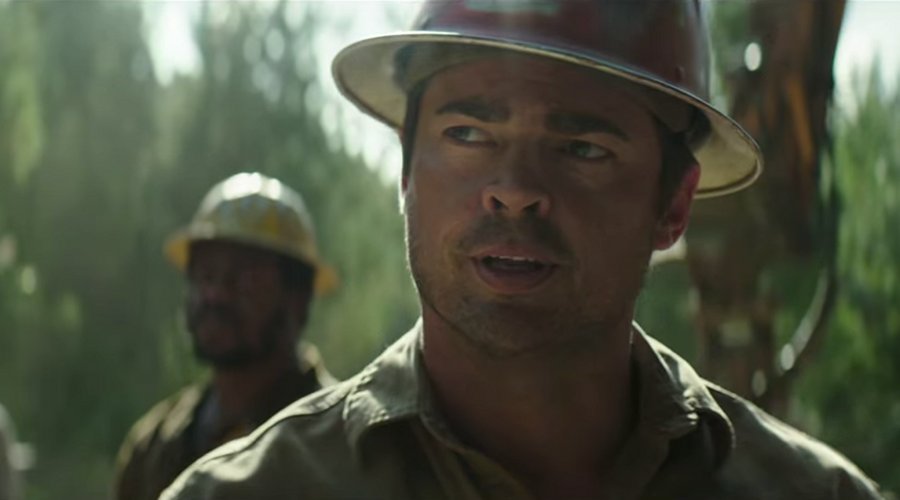
Just remember, we're the bad guys.
If there's one glaring weak point though it's the central conflict. Gavin and his rag-tag group of lumberjacks head into the forest with no plan and seemingly no serious work their leaving behind. Once they come face-to-face with Elliot for the first time, Gavin focuses most of his attention on convincing Jack of what he saw instead of, I don't know, calling the authorities, probing deeper into Pete's story, bringing a bigger posse next time etc.. Granted it's a little refreshing when Redford calls Gavin out after his second run-in with Elliot, concluding "you really don't have a clue do you?" But the characters lack of motivation apart from "git r done" seems less of a villain story oversight and more of a decision by Disney to not make Big Lumber the bad guy this time around.

Elliot's creature design is remarkable given the relatively small scope and occasionally iffy green screen work of the film. He's a cross between the original 2D green goofball and Sully from Monsters, Inc. (2001) only with a snout resembling a dog. It's certainly a different take on the mythical creature and part of me longs for a revival of the Smaug meets Dragonheart (1996) aesthetic but let's not get carried away; this is a Disney movie after all.

As a remake, Pete's Dragon blows the old one out of the water and as a kids movie, the film smuggles in some honest and wholesome family-oriented plot devices. Yet as a movie period, Pete's Dragon is a bit too stiff and a bit too light in the conflict department; even if talented actors like Dallas Bryce Howard and Oakes Fegley are working extra-hard to make ends meet.

Final Grade: C+