Friday, March 17, 2017

A United Kingdom


Year: 2016
Genre: Drama
Directed: Amma Asante
Stars: David Oyelowo, Rosamund Pike, Tom Felton, Jack Davenport, Laura Carmichael, Terry Pheto, Jessica Oyelowo, Vusi Kunene, Abena Ayivor, Arnold Oceng, Theo Landey, Jack Lowden
Production: BBC Films

In a word, A United Kingdom is handsome. To loan it another, it’s also stately; handsome and stately, stately and handsome. Both words immediately conjure memories of Enchanted April (1991) or anything adapted from a Jane Austen novel. The kind of movie with people walking down hallways and through courtyards looking flustered. Handsome and stately; But is it important?

Are you telling me there won't be an estate dinner?
Director Amma Asante and screenwriter Guy Hibbert seem to think so, pitting the film’s protagonists against Winston Churchill while evoking memories of no less than Nelson Mandela. Of course it has good reason to; A United Kingdom is not a work of fiction but rather an inspiring true story of an African king and a British subject who chooses to be his queen. The story of Seretse Khama (D. Oyelowo) and the lovely Ruth Williams (Pike) starts like most great romances do, with the intense locking of eyes and a world of obstacles lying in waiting. The two court and marry within the first act and make their way to Bechuanaland (now Botswana) where trouble takes the form of familial tensions and geo-political intrigue. Can their love survive the ever-mounting pressures of the British Crown and neighboring Apartheid period South Africa? Or will the marriage crumble like the infrastructure of what was then the poorest country on Earth.

That very question, the limits of their undying love, forms the nucleus of A United Kingdom, the implications of which wrap the story like pink colored cellophane. The events of the film span a decade and during all that time, what we mostly get is the same sanitized story beats as a Disney Princess movie. Not much in the way of global politics or economics and nothing but what you’d expect as far as period appropriate racism. It’s all done so safely; so demure and limited by superficial pomp.

If you liked A United Kingdom, you may also like Belle!
The irony of course is director Amma Asante seems to really care about these sorts of true-life stories. Her last film Belle (2013), worked within the confines of a stuffy period piece, to call attention to an obscure life at the nexus of racism and aristocracy. But while that movie had the luxury of gifting its audience something new into familiar wrapping, A United Kingdom can’t really break free from its own limitations. We’ve seen this all before the only difference is the specter of Apartheid isn’t personified by a severe man twirling his mustache.

I'm sure he's a nice guy in real life...
The British Empire however is personified in Jack Davenport and Tom Felton. Both play British functionaries whose sole job is to pull our two lovebirds apart, and boy do they ever relish their roles. Jack Davenport specifically is at pinnacle Larry Grey; his debonair smugness is so deliciously Anglo that birds would mistake his upturned nose for a littoral cave. Likewise Felton is the epitome of priggishness, a muscle he has toned and perfected with every Harry Potter (2001-2011) installment. While I’m a little sad that franchise has relegated him to play weaksauce villains for the rest of his life, there’s a consolation in knowing there are worse fates for child actors turned adult.

As for Rosamund Pike and David Oyelowo, they both do splendidly; though is there any doubt that they wouldn’t? Both are gifted actors and both do what is required of them which mostly consist of holding hands and looking like the weight of the world is on their shoulders.

So A United Kingdom may not ultimately be an important movie. Yet its heart is inarguably in the right place. It manages to tell a lovely real-life Cinderella story with accomplished actors doing their best to do their historical analogs justice. The faults lay with the direction and tone of the film which certainly isn’t enough to mar the film. Yet considering how safe it ultimately ends up feeling, I doubt the film is doing the legacy of the Khama’s any favors.

Final Grade: C+

Thursday, March 16, 2017

Table 19


Year: 2017
Genre: Comedy
Directed: Jeffrey Blitz
Stars: Anna Kendrick, June Squibb, Lisa Kudrow, Craig Robinson, Tony Revolori, Stephen Merchant, Wyatt Russell, Andrew Daly, Maria Thayer, Becky Ann Baker, Margo Martindale, Rya Meyers, Thomas Cocquerel
Production: 3311 Productions

I’ve been reviewing films off and on for about five years. And if there is one thing I’ve learned about criticism is that the vast, unchallenged mean between absolutely great movies and downright terrible ones hides a lot of non-committal fence sitting. I’m guilty of it myself; in today’s age of instant self-gratification, it’s easy to cobble together a knee-jerk opinion based on someone else’s ideas. Problem is those ideas, whether valid or not, sometimes creates a subterfuge of undeserved hype or undeserved vitriol depending on the circumstance. They feed a cycle of wafer-thin subjectivity masquerading as authoritative proof of something’s worth. This is why, for example a movie like Equilibrium (2002) can be seen as something more than a splashy Matrix (1999) rip-off while movies like Mystery Team (2009) are swept under the rug.

Seriously, who still likes this movie?
So it is with Table 19, a movie no one will likely see because the critical consensus is so bad that it’s created its own negative feedback loop. Table 19 takes place over the course of several hours of a wedding reception at a rustic hotel lodge. As the happy couple celebrates their new marriage amid friends and family, a small group of strangers sit at the back table, forcing uncomfortable banter and gracelessly ignoring the reason for their position in the back. Among them are the argumentative Kepps (Kudlow and Robinson), the dotty Ms. Jo (Squibb), gawky teen Renzo (Revolori), distant cousin Walter (Merchant) and Eloise (Kendrick) the disgraced ex-Maid of Honor who was dumped by the Best Man (Russell).

To say Table 19 is “ridiculous and a mess,” is a bit of an understatement. As critics rightly point out, the pacing is stop and go, the editing is slapdash and the high-concept simply doesn’t have the wherewithal to make it through a feature-length movie. Once the initial awkward niceties are flushed under the force of the first big narrative reveal, the film descends into a checklist of soapy plot-points and lazy character short hands. Much like 8 Heads in a Duffel Bag (a similarly imperfect ensemble farce), Table 19 klutzily mixes its farcical elements with broad, sweeping story setups and has them slosh about until the runtime wears out. On top of it all, the tone shifts wildly depending on who you’re following at the time.

Hello!!!
Thing is, I actually liked 8 Heads in a Duffel Bag, and I liked Table 19 too for much the same reason. The characters, as broad as they may be at times never ceased to entertain; Stephen Merchant’s portrayal as a familial pariah Franken-walking through the banquet hall is worth the admission price alone. As are Renzo’s far too honest conversations with his mother (Martindale in a superb unseen role) which mostly consist of him rolling his eyes while she pushes him to “get laid already.” Behind the Kepps’ increasingly hostile quibbling and Grandma Jo’s insistence that she’ll be remembered (just you wait), lays a unified feeling of melancholy.

That feeling of melancholy along with some solid comedic setups and payoffs permeate through the film’s cosmetic faults. Every time you’re distracted by an awkward cut or taken aback by some of the more hammy moments, the film quickly lulls you back with its quixotic charm.

Helping to dry up this mess and put it back into a nice looking bucket is the relentless Anna Kendrick who by now has turned the neurotic jilted girl archetype into a symbol of quasi-empowerment. While she wins no brownie points for that here, there’s something near noble about the way she throws herself into the fray. She easily elevates an already stellar cast and sells the hell out of the movies main conceit.

Come on guys, it's not that bad!
Much like the twangy banjo version of Pachelbel’s Canon in D that plays over the film’s title sequence, Table 19 is a unique version of a very old cultural tradition. It’s certainly not the best version of what it could be but with more than a handful of charming performances, this delightful little farce deserves a little better than the wedding inspired japes it’s been getting from critics. Perhaps it’s a case of ugly duckling syndrome on my part, but I’m going to go ahead and say “I Do” to this one.

Final Grade: B-

Tuesday, March 14, 2017

Beauty and the Beast

Year: 2017
Genre: Romantic Musical
Director: Bill Condon
Stars: Emma Watson, Dan Stevens, Luke Evans, Josh Gad, Kevin Kline, Hattie Morahan, Ewan McGregor, Ian McKellen, Audra McDonald, Stanley Tucci, Emma Thompson, Gugu Mbatha-Raw
Production: Walt Disney Pictures

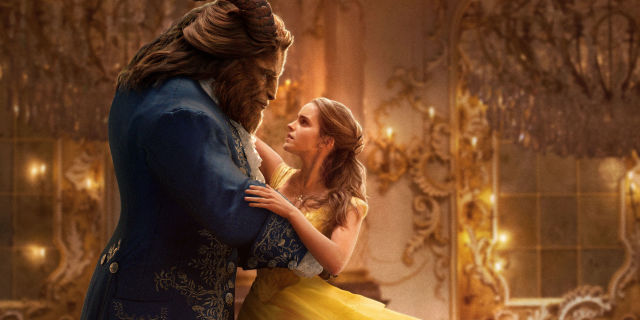
Disney continues its unprecedented line of rebooted, re-imagined, and refurbished live-action remakes with the new fangled Beauty and the Beast. And much like last year’s Jungle Book (2015) and Pete’s Dragon (2015) this one injects just as much chemical perfection into its innards as a robot arm would bestow a Twinkie. It’s not a necessary movie per se. But its unabashed zeal and fidelity to the source material (the Disney-fied 1991 film not the Jeanne-Marie Leprince de Beaumont tome) has a certain giddiness to it; a certain manufactured innocence.

We promise whimsy...or else!
I'm sure we're all well versed by now on the self-described "Tale as Old as Time." A precocious Belle (Watson) falls in love with a surly Beast (Stevens) whose secret heart of gold is hidden underneath layers of loneliness, sadness and fur. There's an enchanted castle, a witch’s curse, singing silverware, inexplicable walks through wintry forests without a coat - its basic fairy tale stuff really. Difference this time is Disney has carefully and lovingly set its story on its perch like butterfly taxidermy in frame. Most everything you remember from Beauty and the Beast (1991) is in this film, and everything you don't remember is just a tiny bit better.

What parts you may ask? Well arguably the best thing about Beauty and the Beast is the way it quietly updates the gender politics of the material and does so without feeling pushy or preachy. Much ado was made of the ultimately benign gay character that nearly everyone failed to notice the first (and second) bi-racial kiss in a Disney film. As for Belle, Paige O’Hara certainly had her moment as the progressive page-turning princess but Emma Watson’s take on the character comes with a dream of travelling to the great white somewhere and (sort of) accomplishes it. Speaking of which, Watson positively runs away with this role; dawning natural sincerity while belting out gorgeous melodies like she’s not even trying.

Do you remember Gaston? In the animated version, the vain hunter-in-chief of Belle's little town had all the charm of a nefarious, dark-haired Johnny Bravo. Here however Luke Evans’s meat-headed take on the popular villain pops with campy fun. His interactions with LeFou (Gad), up to and including the song “Gaston,” are easily the best parts of the movie.

This book will take you anywhere in the world except Detroit.
Yet while these minor improvements are sure to win over the nostalgic, the case against Beauty and the Beast proves much more interesting, at least from a filmic perspective. First let’s start with the added songs provided by B&B originator Alan Menken and replacement lyricist Tim Rice. While the songs do their best to slink underneath the film’s major melodies, their lack of Howard Ashman’s lyrical wordplay and effortless charm clash like burlap underneath layers of purple satin.

My God, this character design is awful!
Additionally Bill Condon’s persnickety attention to detail works for the mechanics of the film to the detriment of the narrative. Every cut, every structural progression, feels stiflingly familiar, and can’t help but make everything look paler when compared to the original. Considering the way the film was shot and cut, the middling filler looks presentable while the big scenes all seem overwhelmed by clutter. This is most evident in “Be Our Guest,” when Lumiere (McGregor) our photo-realistic French candelabra fills the screen with gauche CGI chaos. It is at that moment I realized; the best part of the 1991 version is the worst part about this one.

Gee, I wonder what's going to come to theaters next...
Yet despite, its various faults, I can’t help but admire this posh little remake. It’s a begrudging admiration, like the kind of ambivalence I increasingly feel towards Marvel movies. Only unlike Marvel, which tricks you into thinking you haven't seen all this before, Disney live-action remakes all but announce you've seen this all before, only you shouldn't care. It looks like we’ll have to wait a little bit longer before killing this beast.

Final Grade: B-